

Nevesh | August 2026
There is a familiar way of telling an Indian startup story.
A founder spots a large market. A product follows. Customers arrive. Investors come in. Revenue scales. The company expands into new cities.
Akshayakalpa’s story does not fit that template very neatly.
The company started in 2010 with a much less glamorous question: why are young Indians leaving farming?
Shashi Kumar knew the answer from personal experience.
He had grown up in a farming family, then taken the route his generation was encouraged to take. He studied engineering, built a 17-year career in technology, including 13 years at Wipro, and eventually worked in the US. His father, like many farmers of his generation, did not want his son to return to agriculture.
The irony was hard to miss.
The son who had been told to stay away from farming eventually came back to try to make it a viable profession.
That decision became Akshayakalpa.
Sixteen years later, the company has become a profitable dairy business doing roughly ₹60 crore a month, according to Shashi Kumar’s recent conversation on the Prime Venture Partners Podcast. It works with about 2,800 farmers, including 1,200 women farmers. The average monthly payout to a farming family was ₹1.28 lakh last financial year, according to the same conversation.
The number that stands out, however, is not the revenue.
It is the 2,800.
Because Akshayakalpa’s bet has never really been about collecting the largest possible network of farmers.
It has been about making each farmer’s farm economically stronger.
And that distinction explains much of what makes the company interesting.
The business started with a farming problem, not a dairy problem
Akshayakalpa was founded by Shashi Kumar and Dr G.N.S. Reddy.
Before the company existed, there was already a broader effort around rural entrepreneurship. The idea was to encourage young people to see agriculture as a profession rather than something they inherited because they had no other option.
The company’s own account traces its roots to the Youva Chethna programme and the conversations that eventually led to Akshayakalpa being seed-funded in 2010. Twenty-seven professionals, many connected to Shashi’s Wipro years, backed the effort at a time when there was little reason to believe an organic dairy business would become a large consumer company.
The first question was not:
How do we sell more milk?
It was:
How do we make farming financially attractive enough for the next generation to stay?
That led to an important realisation.
Farmers cannot build a livelihood around promises of future income. They need cash flow.
Dairy offered something crops often could not: a regular source of income.
Milk could be produced and sold every day.
So dairy became the starting point.
But milk was never supposed to be the entire answer.
The milk was the entry point. The farm was the business.
This is where Akshayakalpa’s model differs from a conventional dairy company.
The company does not own the farms from which all its milk comes.
Instead, it works with farmer-entrepreneurs, trains them and helps them build productive farm systems.
Its own description of the model is built around grooming young farmers to establish profitable dairy farms. Farmers are trained and monitored over a period of roughly 12–18 months, while the company provides support across farming operations.
That means Akshayakalpa’s supply chain begins much earlier than the milk collection point.
It starts with the soil.
The company works with farmers on fodder, soil management, animal care and farm economics. Its model also includes manure-making, beekeeping, backyard poultry, banana cultivation and other forms of diversification.
The idea is to make the farm less dependent on one source of income.
That is a subtle but important difference.
Many agriculture businesses make money by selling something to the farmer.
Akshayakalpa’s model is built around the question of whether the farmer makes money after buying it.
Shashi Kumar has been unusually direct about this distinction.
A tractor company can sell a tractor without knowing whether the farmer becomes more profitable. A seed company can sell seeds without taking responsibility for the farmer’s eventual economics.
Akshayakalpa is trying to put the farmer’s income closer to the centre of the business model.
That makes the company more complicated to build.
It may also explain why it took so long.
Sixteen years is a long time in startup India
Akshayakalpa did not become a large consumer business overnight.
In fact, the company came close to shutting down multiple times.
According to Shashi Kumar’s recent Prime Venture Partners conversation, there were six occasions when the company seriously considered closing the business. For the first nine years, survival was a bigger achievement than hypergrowth.
That period matters because it changes how the company’s eventual scale should be viewed.
Akshayakalpa was not built during the era when every startup was expected to chase a national footprint immediately.
The company spent years figuring out something much harder: whether farmers could consistently produce the quality of milk it promised consumers, and whether consumers would pay enough for it.
That took time.
It also required a different kind of capital.
The company went without institutional funding for its first nine years, according to Kumar’s account. During difficult periods, the original group of supporters helped keep it alive.
The eventual institutional money came much later.
Lok Capital invested in 2019. British International Investment, Rainmatter and Venture Dairy backed a Series B round in 2022. A91 Partners led a Series C investment in 2024, with British International Investment and Rainmatter participating again.
And in the company’s latest financing, ABC Impact led a Series D round, with participation from Catamaran Ventures, Asha Ventures and existing investors including A91 Partners and Rainmatter. The transaction was reported at about ₹418 crore, including a sizeable secondary component.
The funding history tells its own story.
Akshayakalpa did not raise money first and figure out the business later.
It spent years figuring out the business and raised institutional capital as the model became more established.
Why the company works with one farmer in a village
One of the more unusual parts of Akshayakalpa’s model is its approach to expansion.
The company has spoken about working with one farmer in a village and turning that farmer into a local example.
It sounds small.
That is precisely the point.
If one farmer can demonstrate that dairy farming can produce a better livelihood, neighbouring farmers do not need a marketing campaign to understand the proposition.
They can see it.
The successful farmer becomes the evidence.
Akshayakalpa calls these farmers role models. The company then allows successful practices to spread through the surrounding community.
This also explains why the company cannot simply announce that it will enter a new geography next month and instantly build a local farm ecosystem.
Soil takes time.
Fodder systems take time.
Farmer relationships take time.
Animal health takes time.
Trust takes time.
The Prime Venture Partners episode says individual clusters can take nearly seven years to build properly.
For investors accustomed to software businesses where a new city can be opened with a sales team and a marketing budget, this is a very different kind of scale.
Akshayakalpa’s expansion is biological before it is commercial.
The premium milk is only the visible part
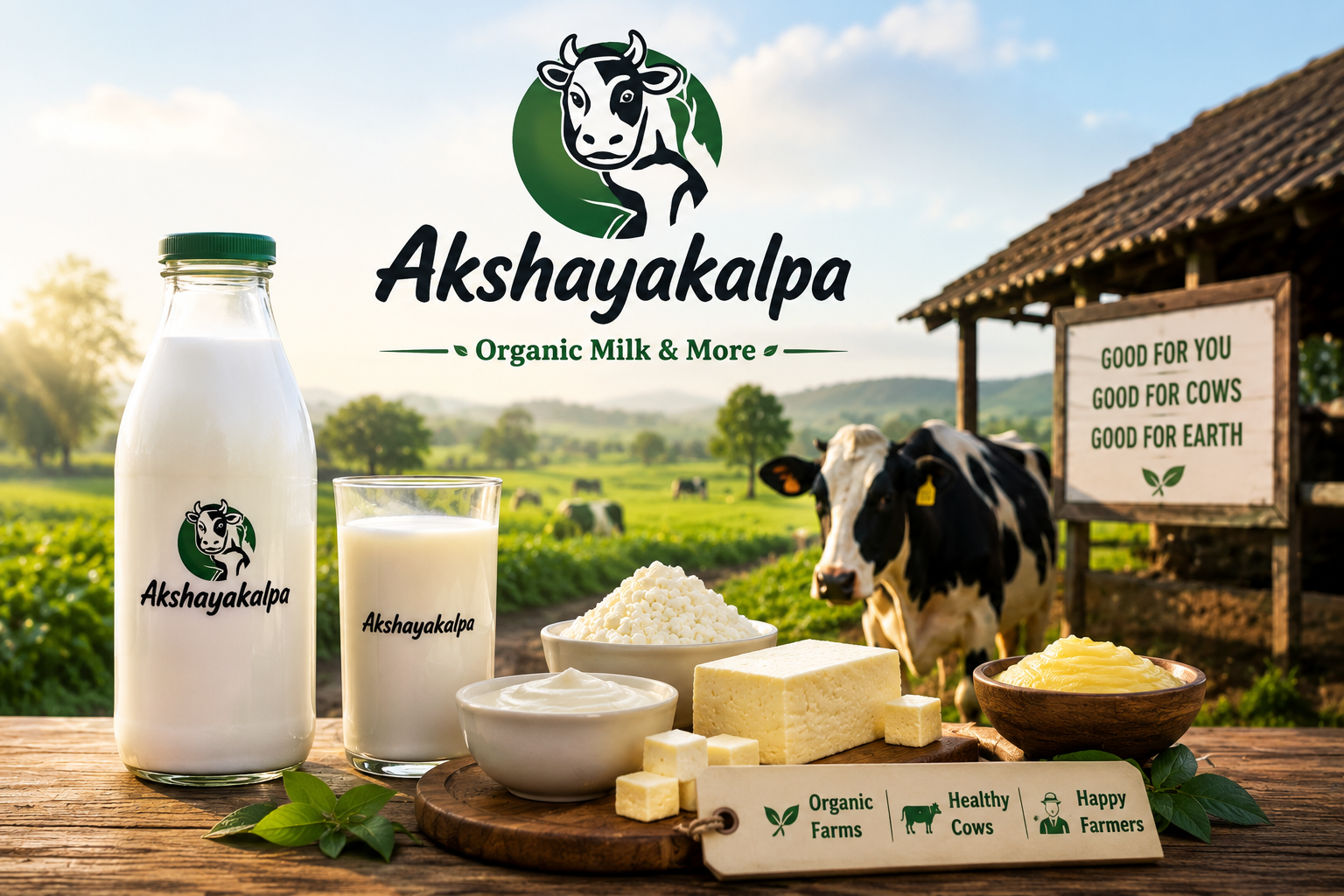
Consumers generally encounter Akshayakalpa as a premium organic dairy brand.
Milk is the biggest part of the business, but the portfolio has expanded into ghee, butter, curd, paneer, cheese, buttermilk and other products. The company has also entered the high-protein dairy category.
That matters because the company’s economics cannot depend forever on selling one litre of milk at a premium.
The larger opportunity is to build a trusted food brand around the farm-to-home relationship.
That is also why Akshayakalpa has spent years taking consumers to farms.
More than 45,000 customers have visited its farms, according to the Prime Venture Partners podcast.
For a food company, that is more than a brand-building exercise.
It addresses one of the biggest problems in modern food businesses: consumers rarely know where their food came from.
Akshayakalpa’s answer has been to shorten that distance.
Let consumers see the farms.
Let them meet farmers.
Show them how the cows are cared for.
Show them how the milk is collected, tested and transported.
Then ask them to pay a premium.
That is a much stronger proposition than simply putting the word “organic” on a packet.
Organic is a process, not a marketing sticker
This is another part of the Akshayakalpa story that deserves more attention.
The company describes itself as India’s first certified organic dairy enterprise and says its products are certified under relevant organic standards. Its processes include organic fodder, soil management, animal care, farm-level chilling and repeated quality checks.
Milk is chilled to around 4°C after milking, and the company says it maintains a continuous cold chain through distribution.
The point is not that these processes automatically make the product superior in every respect.
The point is that organic dairy is expensive to build.
It requires the company to influence what happens before milk reaches the processing facility.
That creates a deeper relationship with farmers, but it also creates a barrier for competitors.
Anyone can launch a premium milk brand.
Building a network of farmers, changing farming practices, maintaining traceability and convincing consumers to pay more for the resulting product is considerably harder.
That is where Akshayakalpa’s moat may lie.
Not in the milk packet.
In the system behind it.
The economics are beginning to catch up with the ambition
The numbers show how far the company has travelled.
Akshayakalpa’s operating revenue was around ₹387 crore in FY25, according to Venture Intelligence data.
By FY26, the company was targeting ₹550–600 crore in revenue, while April 2026 reports said the business had already achieved about ₹400 crore in sales in Bengaluru alone and was investing to build its presence in Mumbai and Pune.
The latest Prime Venture Partners conversation puts the business at around ₹60 crore in monthly revenue and describes it as profitable.
The company has also demonstrated that premium pricing can work in dairy when the customer believes the underlying proposition.
Its products typically command a significant premium over mass-market milk brands.
That premium is not simply paying for packaging.
It pays for a more expensive supply chain.
Organic fodder.
Farmer support.
Quality control.
Cold-chain logistics.
Traceability.
And, increasingly, a brand that has built consumer trust over years.
That is why the company’s growth should not be judged only by litres sold.
The more interesting question is whether it can maintain its economics as it enters larger and more competitive markets.
Mumbai and Pune are the real test
In April 2026, Akshayakalpa formally entered Mumbai and Pune.
The move takes the company beyond its established southern markets and into one of India’s most competitive premium food markets. It has announced investment in infrastructure and distribution and is taking its dairy portfolio, including high-protein products, into Maharashtra.
The company has also said it plans to build farming clusters around the new markets rather than depend indefinitely on transporting milk from existing ecosystems.
That is the harder part.
Its own founder has described the process as a five-to-seven-year journey for new farming clusters.
So Mumbai and Pune will test more than consumer demand.
They will test whether Akshayakalpa can reproduce its farmer model outside the ecosystems it has spent years developing.
That is the real expansion question.
Can the company’s philosophy travel?
The quick-commerce paradox
There is another interesting change in the business.
Akshayakalpa built much of its early growth around direct relationships with consumers and subscriptions. That model gave the company predictable demand and allowed it to plan deliveries.
Then quick commerce changed the market.
Consumers began expecting milk and other perishables almost immediately.
Akshayakalpa adapted.
According to Shashi Kumar, quick commerce now accounts for a substantial portion of sales, while the company continues to operate its own consumer channels and subscriptions.
That creates a tension worth watching.
Quick commerce can dramatically increase reach.
But a consumer brand can lose some control over its relationship with customers when the marketplace becomes the front door.
Akshayakalpa’s original advantage was direct trust.
Its challenge now is to use quick commerce for distribution without allowing the brand itself to become just another product in a digital grocery basket.
The funding story is changing too
For years, Shashi Kumar was reluctant to build the company around an investor-driven growth narrative.
That restraint helped shape Akshayakalpa. The company had to prove that farmers could earn more, consumers would return, and the unit economics could work.
Today, the investor list is much stronger.
A91 Partners, British International Investment, Rainmatter, Catamaran Ventures and ABC Impact are among the investors associated with the company across its funding journey.
The interesting part is not simply who has invested.
It is what kind of company they are investing in.
Akshayakalpa sits at the intersection of premium consumption, sustainable agriculture, rural livelihoods and food supply chains.
That gives the company an impact story.
But impact alone does not build a ₹500-crore business.
The company now has to show that the farmer-first model can produce attractive commercial returns at a much larger scale.
That is a much more interesting test.
What Akshayakalpa is really building
The easiest way to describe Akshayakalpa is as an organic dairy company.
That description is correct.
It is also incomplete.
The deeper business is a network of farmer-owned production systems linked to a premium consumer brand.
The company is trying to solve three problems at once.
Farmers need better economics.
Consumers want greater confidence in what they eat.
And the company needs enough margin between the two to build a sustainable business.
If any one of those three breaks, the model becomes difficult.
If the farmer does not earn enough, the supply base weakens.
If consumers do not see enough value, the premium disappears.
If the company cannot maintain margins, growth becomes dependent on outside capital.
So far, Akshayakalpa has managed to keep the three connected.
That is what makes the business worth watching.
The bigger agriculture question
India has spent years talking about agricultural technology.
Drones.
Sensors.
AI.
Precision farming.
Digital marketplaces.
These tools have their place.
But Akshayakalpa’s experience points towards a less fashionable problem.
Technology cannot fix farming if farming itself does not make economic sense.
A young person will not necessarily remain in agriculture because a farm has better sensors.
They are more likely to stay if the farm can provide a respectable income, predictable cash flow, social standing and a future for the family.
That is why Shashi Kumar’s argument about ageing farmers is more significant than the organic milk business itself.
The question is not only how India will produce more food.
It is who will produce it 20 years from now.
Akshayakalpa’s answer has been to make farming entrepreneurial.
Its farmer is not merely a supplier.
The farmer is supposed to become a business owner.
That is a very different proposition.
The Nevesh View Point
Akshayakalpa’s most interesting achievement is not that it built a ₹500-crore-plus dairy business.
It is that it spent years resisting the temptation to build the business around the easiest startup metric: speed.
The company grew slowly because the underlying asset could not be rushed.
You cannot compress the time required to improve soil.
You cannot manufacture farmer trust.
You cannot create an organic ecosystem overnight.
And you cannot build a premium food brand simply by buying advertising.
Akshayakalpa took the longer route.
It started with farmers, built the supply system, earned consumer trust and only then pushed harder on scale.
That makes its next phase particularly interesting.
The company now has institutional capital, a recognised consumer brand, a wider product portfolio and ambitions beyond South India. The entry into Mumbai and Pune gives it a much larger addressable market, but also raises the difficulty of reproducing a model that has taken years to establish.
There is also a larger lesson for India’s startup ecosystem.
Some of the country’s most valuable businesses may not be built around the latest technology.
They may be built around problems that have existed for generations.
Akshayakalpa’s problem was farming economics.
Its product happened to be milk.
Its real business is the system that connects a farmer’s income to a consumer’s willingness to pay for better food.
That is why the 2,800-farmer figure matters more than it first appears.
The company is not trying to collect farmers.
It is trying to make each farm work better.
If it can take that model from a few thousand farmers to a much larger network without losing the economics that made it work in the first place, Akshayakalpa could become something considerably bigger than an organic dairy brand.
It could become a case study in how Indian agriculture is rebuilt from the farm outward.
At Nevesh, we look beyond the headline numbers to understand the businesses, founders and ideas shaping India’s next decade of growth.