

For years, Indian healthtech had a fairly predictable rhythm.
You fell sick. You searched for a doctor. You booked a consultation. You got a test. You bought medicines. You went home.
Technology made parts of that journey faster, cheaper and more convenient. Teleconsultation reduced the need to visit a clinic. Online pharmacies brought medicines to the doorstep. Diagnostic platforms made test bookings easier. Hospitals digitised parts of the patient journey.
But the underlying model remained largely the same.
Healthcare stepped in when something had already gone wrong.
That model is now beginning to change.
A new group of Indian startups is building around a different question: what if technology could help people understand deterioration before it becomes disease?
That is the bigger story behind India’s emerging healthtech 2.0.
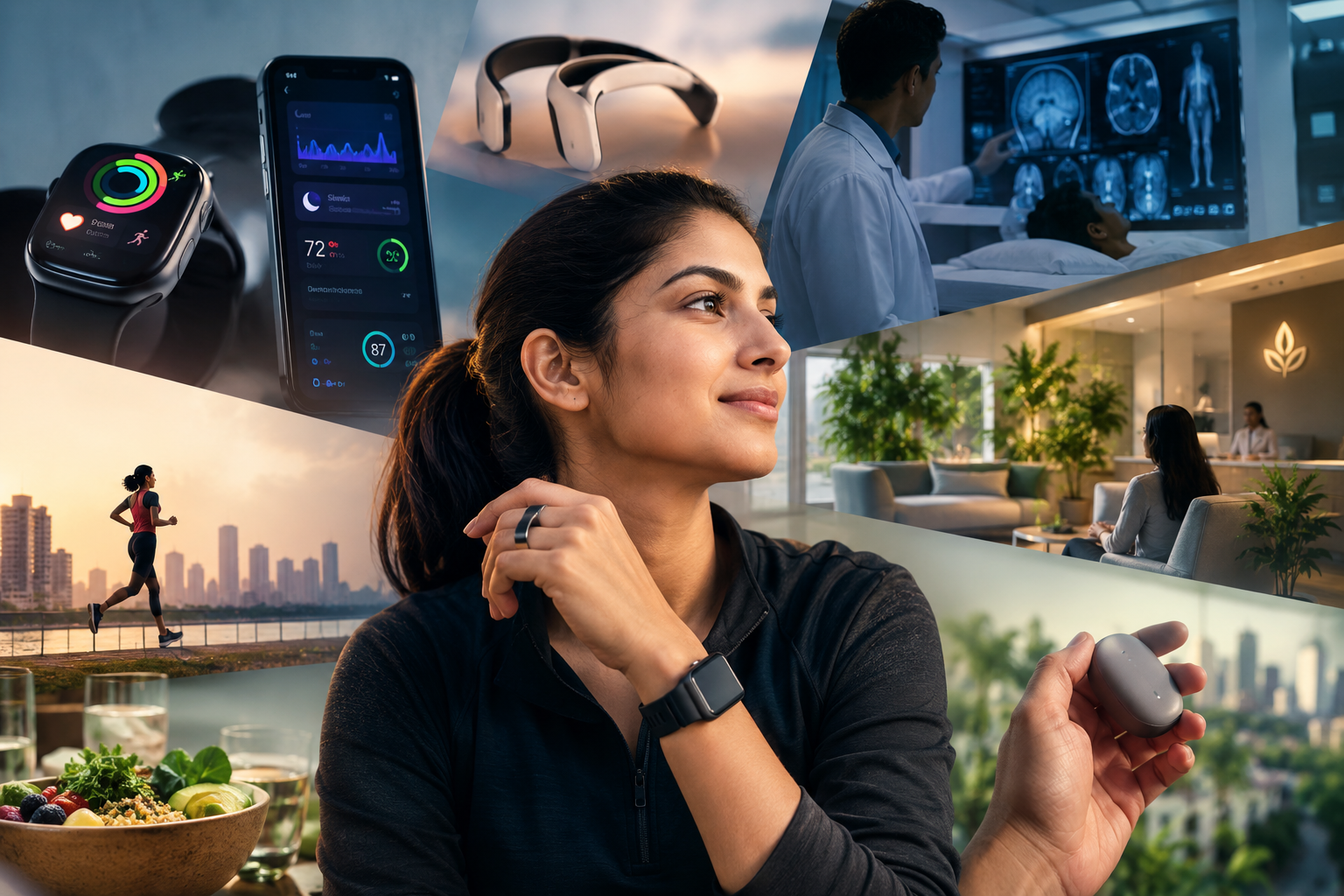
It is not simply about another wearable, another health app or another clinic offering expensive health packages. The more interesting shift is from episodic healthcare to continuous measurement, prevention, personalised intervention and, increasingly, the idea of extending the years a person can live in good health.
The timing is significant.
India’s population is ageing. The number of Indians aged 60 and above is projected to reach about 347 million by 2050, nearly 21% of the population. At the same time, non-communicable diseases are becoming a much bigger part of the health burden.
And there is another uncomfortable reality.
Even as India’s healthcare infrastructure expands, households continue to carry a meaningful part of the cost. The latest National Health Accounts estimates show out-of-pocket expenditure rising to 43.4% of total health expenditure in 2022-23, from 39.4% the previous year.
That creates a large economic incentive to catch health problems earlier.
The question is whether India’s new healthtech companies can turn that opportunity into businesses that work beyond a small affluent consumer base.
The wearable is becoming less about the watch
One of the clearest signs of the shift is happening on the wrist, finger and increasingly elsewhere on the body.
India’s wearable market is not simply growing in volume. In fact, IDC data shows the opposite: wearable shipments fell 4% in 2025 to 114.2 million units, with smartwatch shipments falling 17.6%. But average selling prices increased, suggesting consumers are becoming more selective about what they are willing to pay for.
That matters.
The first generation of India’s wearable boom was largely about price.
Put a screen on the wrist. Add notifications, steps, heart rate and a few sports modes. Sell it cheaply.
That market became crowded.
The next opportunity is different.
Consumers are increasingly paying for interpretation rather than hardware alone.
Apple’s Watch gained sharply in India even while the overall smartwatch market weakened. Counterpoint data reported by TechCrunch showed Apple Watch shipments rising 141% in 2024. The explanation was revealing: experienced users were moving towards devices offering better health insights and tighter integration with their phones.
WHOOP has taken this idea further.
Its 5.0 device is already being sold in India, with more than 14 days of battery life and a proposition built around sleep, recovery, strain, stress and longer-term health. Its higher-tier offering also brings healthspan and pace-of-ageing features.
And this month, Google brought the Fitbit Air to India at ₹13,999.
There is no screen.
That is almost the point.
The product is designed around continuous tracking rather than becoming another screen competing for attention. It tracks activity, sleep and other health signals and connects with Google’s Health Coach.
The market is therefore moving away from the question, “How many features can we put into a wearable?”
The better question is becoming:
Can this device collect useful data continuously and turn it into something a person can act on?
That is a much bigger business.
India’s startups are moving closer to the body
Bengaluru-based Ultrahuman is one of the clearest examples.
It began with a focus on metabolic health and wearables, but its ambition has expanded well beyond the smart ring.
In February, the company launched Ring PRO and its health-data interpretation platform. In September, Ultrahuman announced a $70 million financing round involving investors including Qualcomm Ventures, Labcorp, Alpha Wave, Blume, Nexus and Alteria. The company now describes itself as building a human-computer interface around the body.
That wording matters.
If the company succeeds, the ring is not the final product.
The data is.
A wearable can collect sleep, heart rate, recovery, glucose and other signals. The more valuable layer sits above that: understanding patterns, identifying changes and helping a person decide what to do next.
Ultrahuman’s September launch of Pulsomics shows where this could go. The company is building an opt-in research programme that combines overnight pulse data with lifestyle information, blood panels, continuous glucose monitoring and VO₂ max measurements.
This creates an interesting flywheel.
More users create more longitudinal data.
More longitudinal data can improve models.
Better models can create more useful recommendations.
More useful recommendations can make the device harder to replace.
That is a very different economics from simply selling another fitness band.
Then there is Temple
Perhaps the most unusual Indian experiment is coming from Deepinder Goyal.
His Temple device is designed to sit near the temple and monitor changes associated with cerebral blood flow.
The idea is ambitious because conventional consumer wearables have largely focused on what happens at the wrist.
Temple is attempting to look closer to the brain.
That does not mean its underlying scientific hypothesis should automatically be accepted.
In fact, experts have raised questions about what measuring blood-flow changes at one location can actually tell us about cognition, ageing or neurodegeneration.
But something interesting happened in September.
Temple released findings from an early validation study involving 23 healthy adults. The research suggested that the device could capture changes in blood-flow velocity associated with the brain during exercise and changes in posture. A second study, shared later, compared the device with time-domain near-infrared spectroscopy to examine whether the signal was more closely related to brain blood-volume changes than scalp changes.
The findings still need broader validation.
And that distinction matters.
Healthtech is not like launching another consumer app. A compelling demonstration is not the same thing as clinical proof.
But Temple represents something important for India’s startup ecosystem.
Founders are beginning to fund questions that sit much closer to fundamental biology.
That is a different kind of ambition.
Biopeak is attacking the problem from the clinic
Not every healthtech 2.0 company is starting with hardware.
Biopeak, founded by Rishi Pardal and Shiva Subramanian, is taking a clinical route.
The company describes its approach around preventive and personalised healthcare, bringing together diagnostics, specialist-led interventions, data analysis and continuing follow-up rather than treating every medical interaction as a standalone episode.
The model has attracted serious investor interest.
In January 2026, Biopeak raised $2.7 million in a follow-on round led by Nikhil Kamath’s investment vehicle. The company said the money would support clinical expansion, diagnostics, research and its technology platform, including a new Bengaluru centre.
The distinction is subtle but important.
A conventional health check tells you what your body looks like today.
A longevity-oriented health business wants to understand how that picture is changing.
That means repeated measurements.
It means establishing baselines.
It means tracking metabolic, cardiovascular and other markers over time.
And eventually, it means asking whether an intervention actually changed the trajectory.
That creates the possibility of a recurring healthcare relationship rather than a one-time transaction.
Gabit is betting on the behaviour problem
Gabit approaches the same market from another angle.
Its thesis is that knowing what is good for you is not the same as doing it.
Sleep better.
Exercise.
Eat differently.
Manage stress.
Stay consistent.
Most people already know these things.
The difficult part is sustaining them.
Gabit has built around that behavioural layer, combining wearables, health data and personalised programmes. Its founders have argued that fitness, nutrition, sleep and stress need to be viewed together rather than as separate categories.
This may prove more commercially important than it first appears.
Healthcare has traditionally been very good at responding to symptoms.
It has been much less successful at getting people to change behaviour before symptoms appear.
A device can tell someone that their sleep deteriorated.
A useful product has to answer the harder question:
What should they do about it tomorrow morning?
That is where healthtech companies are trying to build a moat.
And India is getting stranger about what counts as healthcare
The experimentation is spreading into areas that would have sounded unusual in Indian consumer technology a few years ago.
Sychedelic, for instance, is developing smart headphones around stress, focus and sleep. Its product combines physiological sensing with sound and electrical stimulation, and the company says its device has received CDSCO approval and is classified as a Class B device.
The company is effectively asking whether something as ordinary as a pair of headphones can become a health interface.
That is the broader pattern.
Health data no longer needs to come from a hospital machine.
It can come from a ring.
A band.
Headphones.
A glucose sensor.
A blood test.
A sleep tracker.
Or a device sitting against the side of your forehead.
The startup opportunity lies in bringing those signals together without turning the consumer into a full-time patient.
Vytalyou shows where the premium market is going
There is also a more traditional version of this opportunity emerging.
Vytalyou, a Mumbai-based preventive healthcare and longevity company, raised around ₹8-10 crore in growth funding in 2026 at a valuation of about ₹33 crore. It plans to expand beyond its Powai centre, with two more Mumbai locations and ambitions for other Indian cities.
Its model combines diagnostics, imaging and preventive health programmes with interventions aimed at longer-term health.
The economics are straightforward.
A consumer who is willing to spend significantly on health is no longer buying only a yearly blood test.
They may buy a programme.
They may return for repeat measurements.
They may use a wearable between clinical visits.
They may pay for interpretation.
They may buy interventions.
For a startup, that creates a much larger lifetime value opportunity than a one-off diagnostic.
But it also creates the biggest problem facing the entire sector.
The affluence problem is real
India’s healthtech 2.0 story can easily become a story about wealthy Indians buying expensive ways to monitor themselves.
A ₹20,000-plus wearable is not mass-market healthcare.
A premium longevity clinic is not mass-market healthcare.
Advanced diagnostics, specialist consultations and continuous monitoring add up quickly.
WHOOP’s India pricing, for instance, starts around ₹21,990 for its current ONE offering, while its higher Peak tier is listed at ₹28,990.
That is a very different consumer proposition from the low-cost smartwatch market that helped create India’s enormous wearables base.
And this is where the Healthtech 2.0 thesis gets complicated.
The people most able to afford sophisticated prevention are not necessarily the people who face the greatest healthcare constraints.
India still has large differences in healthcare access, income, specialist availability and health awareness.
So the first customers for longevity businesses are likely to be affluent urban professionals.
That is not necessarily a weakness.
It may simply be the first stage of the market.
Premium customers can finance product development.
Hardware costs can fall.
Data sets can become larger.
Clinical protocols can become better tested.
Distribution can widen.
The real test is whether those companies eventually move down the price curve without destroying the quality of the service.
The bigger opportunity may not be longevity
There is a temptation to treat longevity as the next consumer buzzword.
That would miss the larger opportunity.
The real prize is continuous health management.
Consider the difference.
A traditional healthcare system waits for an event.
A preventive system watches for risk.
A continuous system watches the person.
That distinction changes the business model.
Instead of a customer appearing when something hurts, the company has a relationship with the customer every day.
Instead of one blood report, there is a history.
Instead of one consultation, there is longitudinal context.
Instead of telling someone that their health is “normal”, the product can show whether their own baseline is changing.
That creates a much more valuable dataset.
It also creates a much more difficult product to build.
Because collecting data is easy.
Knowing which data matters is harder.
Knowing whether a change is meaningful is harder still.
And turning that insight into an intervention that genuinely improves outcomes is the hardest part.
Big Tech’s role is becoming clearer
This is also why the arrival of global technology companies matters.
Apple entered India with Fitness+ in December 2025 at ₹149 a month or ₹999 a year, adding a subscription layer to its existing device ecosystem.
OpenAI’s Health product has taken a different route, bringing health information, medical records and wellness data into a dedicated experience. However, as of the latest official information, Health is being rolled out to eligible users in the US, rather than representing a confirmed India launch.
That correction actually makes the Indian story more interesting, not less.
India does not need Silicon Valley to declare the market ready.
Local companies are already experimenting with the pieces.
Global companies are adding pressure from another direction.
Google is now selling a screenless health tracker in India.
WHOOP is selling recovery and healthspan tracking.
Apple is monetising fitness subscriptions.
Ultrahuman is building a broader health-data platform.
Temple is experimenting with brain-related measurements.
Biopeak and Vytalyou are building physical longevity services.
The market is beginning to form around the same idea from multiple directions.
The next healthtech winner may own the context
The obvious question is which wearable will win.
That may be the wrong question.
The more interesting battle could be over who owns the user’s health context.
Imagine a person whose wearable knows how they slept.
Their glucose sensor knows how their body responded to food.
Their blood tests show changing metabolic markers.
Their activity data shows declining fitness.
Their medical records show a family history.
Their nutrition data explains part of the pattern.
The company that can responsibly bring those pieces together has something much more valuable than another step counter.
It has a longitudinal picture of the person.
That is where the real defensibility could emerge.
But there is a catch.
Health data is not ordinary consumer data.
Privacy, consent, security, medical claims, clinical validation and regulatory oversight become central to the business.
The companies that treat those issues as product foundations will have a better chance of surviving the next phase than those that simply turn every biometric into another score.
India may build a different version of longevity
There is another reason to watch this market closely.
India does not have the same healthcare economics as the US, nor the same ageing profile as Japan.
It has a huge young population, rapidly expanding urban incomes, rising chronic disease, a large digital consumer base and an ageing population arriving at the same time.
That creates a strange combination.
The Indian longevity customer may not be someone trying to live to 120.
It may be a 38-year-old professional worried about sleep, weight, blood pressure, metabolic health and the possibility of spending the second half of life managing chronic disease.
That is a much larger market.
The product does not have to promise immortality.
It has to make the next 20 years healthier.
The Nevesh View Point
India’s healthtech opportunity is moving beyond the old question of how to make healthcare more convenient.
The next question is whether technology can make healthcare more anticipatory.
That shift could create an entirely new category of businesses.
But investors and consumers should be careful about confusing sophisticated technology with better healthcare.
A beautiful dashboard is not a medical outcome.
A wearable reading is not a diagnosis.
A longevity package is not proof that ageing has been slowed.
And a scientific hypothesis is not yet a clinical breakthrough.
The companies worth watching will be the ones that can connect three things: good science, measurable outcomes and a business model people can afford to stay with.
That last part may decide the market.
India’s affluent consumers can finance the first wave of Healthtech 2.0.
They cannot, by themselves, create its final form.
For the sector to become truly important, the technology will eventually have to move from premium wellness into mainstream prevention.
That means lower prices.
Better evidence.
Stronger clinical partnerships.
Simpler products.
And health insights that people can actually use.
The most interesting Indian healthtech company of the next decade may therefore not be the one selling the most expensive wearable or the most futuristic longevity package.
It may be the one that figures out how to make prevention feel as normal, affordable and habitual as checking a bank balance.
That is when Healthtech 2.0 stops being a premium consumer trend and starts becoming infrastructure.
Frequently Asked Questions
What is Healthtech 2.0?
Healthtech 2.0 refers to the shift from technology mainly helping patients access episodic healthcare towards continuous health monitoring, prevention, personalised interventions and longer-term health management. The model brings together wearables, diagnostics, digital health records, data analysis, clinical services and behaviour change. The important change is not simply the technology itself. It is the relationship with the consumer. Instead of engaging only when illness appears, companies attempt to stay connected to a person’s health over months and years.
Why is longevity becoming a bigger startup opportunity in India?
India is ageing while also dealing with a growing burden of chronic and non-communicable diseases. The population aged 60 and above is expected to reach around 347 million by 2050. That creates demand for earlier detection, better monitoring and interventions aimed at maintaining health rather than only treating disease after it appears.
Which Indian startups are building in this space?
The emerging ecosystem includes companies taking very different approaches. Ultrahuman is expanding from wearables into a broader health-data platform. Temple is experimenting with brain-related measurements. Biopeak is building preventive and longevity-focused clinical services. Gabit combines wearables with health and behaviour programmes. Vytalyou is building physical preventive-longevity centres. Sychedelic is working on smart headphones aimed at stress, focus and sleep. These companies are not identical, but they are responding to the same larger shift towards continuous health management.
Is India’s wearable market actually growing?
Not necessarily in unit terms. IDC data shows India’s wearable shipments fell 4% in 2025, while smartwatch shipments declined 17.6%. But average selling prices rose, indicating that consumers are becoming more selective and that premium health-focused devices can still find demand. Apple, WHOOP, Ultrahuman and Google’s Fitbit Air are examples of companies targeting consumers who want more specialised health and wellness functionality.
What is the biggest challenge for India’s longevity startups?
Affordability is one of the biggest challenges. Advanced diagnostics, specialised hardware, clinical expertise and continuous monitoring can make these businesses expensive. Most early customers are therefore likely to come from affluent urban markets. The long-term challenge is to reduce costs and simplify delivery enough to reach a much wider Indian population without compromising clinical quality.
Can wearable devices replace doctors?
No. Wearables can collect useful signals and help people identify patterns, but they do not automatically provide a medical diagnosis or replace clinical judgement. Even sophisticated products need proper validation, appropriate interpretation and responsible use. The strongest healthtech businesses are likely to use technology to improve the connection between consumers, data and healthcare professionals rather than pretend the doctor is no longer necessary.
What should investors watch in India’s Healthtech 2.0 market?
The most useful signals may be less glamorous than launch announcements. Watch customer retention, repeat usage, clinical validation, measurable health outcomes, recurring revenue, cost of acquisition, affordability and whether companies can expand beyond wealthy metropolitan consumers. The winners are likely to be those that turn health data into useful decisions and build relationships that last for years, rather than simply selling another device.
Risk Disclaimer: This article is for general financial awareness and education. Rules, procedures and documentation requirements can change. Readers should verify their individual claim requirements directly with the relevant insurer and IRDAI’s official channels.