

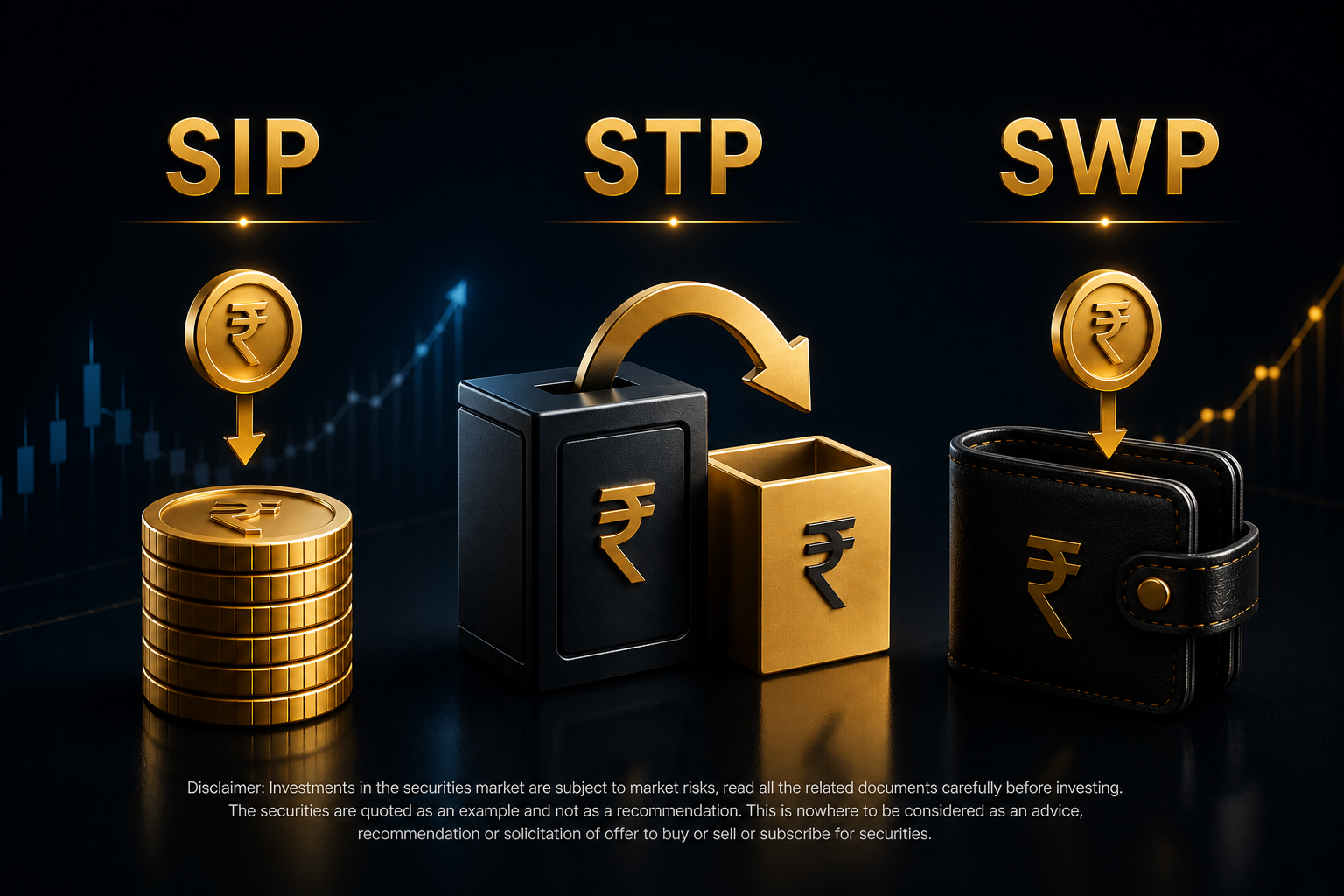
Systematic Investment Plans (SIP), Systematic Transfer Plans (STP), and Systematic Withdrawal Plans (SWP) are three popular tools in mutual fund investing, each serving a different purpose. A SIP is a way to invest a fixed amount at regular intervals (usually monthly) into a mutual fund. This disciplined approach helps you invest consistently without worrying about market timing.
SIPs benefit from rupee-cost averaging you buy more units when the market is down and fewer when it’s up – which smooths out volatility over time.
They also leverage the power of compounding: earnings are reinvested, so over long periods even small, regular investments can grow significantly. In fact, you can start with as little as ₹500 per month, making SIPs ideal for salaried investors or anyone with regular income and long-term goals (like retirement or a child’s education).
Key features of SIP: Regular fixed investments; rupee-cost averaging reduces timing risk; long-term compounding boosts returns
Why use SIP: It builds disciplined investing habits and gradually accumulates wealth. For example, a ₹5,000 monthly SIP at an average 12% return can turn a total investment of ₹9 lakh into about ₹25 lakh over 15 years, illustrating how consistency and compounding magnify wealth.
Systematic Transfer Plans (STP) are for deploying a lump sum amount gradually across funds, rather than investing it all at once. With an STP you park your lump sum in a low-risk fund (like a liquid or debt fund) and then set up a transfer of fixed amounts at regular intervals into another scheme, typically equity. This phased transfer reduces market-timing risk because you’re spreading out your entries into the market.
For example, instead of putting ₹5 lakh all at once into an equity fund, an STP might move ₹25,000 per month into equity while the rest stays in a stable fund. This way, your idle cash can still earn some return, and you avoid buying at a single market high. STPs are commonly used when you receive a windfall (bonus, inheritance, etc.) and want to stagger your investment into riskier assets. In short:
Key features of STP: Transfers funds within the same fund house (debt → equity or vice versa); spreads out a lump-sum investment over time.
Why use STP: It mitigates the risk of entering the market at the wrong time and makes better use of idle cash. Each transfer is technically a redemption from one fund and purchase in another, so STPs require attention to tax and exit-load implications.
Systematic Withdrawal Plans (SWP) work in the opposite direction of a SIP. Instead of adding money, you withdraw a fixed amount from your mutual fund investment at regular intervals (monthly, quarterly, etc.) and the rest of the corpus stays invested. SWPs are designed to provide a steady cash flow from your accumulated corpus. For example, a retiree might set up an SWP to take ₹20,000 per month from their mutual fund holdings to cover living expenses. At each withdrawal, the fund redeems the necessary number of units at the current NAV and pays you the amount. The remaining units continue to stay invested, so your money can keep growing even as you draw it out.
Key features of SWP: Regular withdrawals from your fund; only the withdrawn part is redeemed (the rest remains invested).
Why use SWP: It provides predictable income (useful in retirement or for recurring needs) while still allowing some money to compound. SWPs are often more tax-efficient than liquidating an entire investment at once. (Withdrawals from equity funds held >1 year qualify for long-term capital gains rates, while debt fund withdrawals held >3 years get indexation benefits.)
SIP vs STP vs SWP: Comparing the Three
All three are systematic plans, but they differ in purpose and cash flow direction:
- Direction of cash: SIP moves money from your bank to the fund (inflow). STP moves money from one fund to another (internal transfer). SWP moves money from the fund to your bank (outflow)
- Purpose: SIP is for regular investing and wealth creation. STP is for gradual deployment of a lump sum or rebalancing between funds. SWP is for generating regular income from an existing corpus
- Ideal investor: SIP suits new investors or those with steady income. STP suits someone with a lump sum to invest. SWP suits retirees or anyone needing ongoing cash flow
- Risk management: SIP uses rupee-cost averaging to reduce market-timing risk
- STP smooths entry into the market, reducing the risk of bad timing on a lump sum
- SWP requires careful planning – withdrawing too much too fast (or during market lows) can exhaust your capital
.
Each method is complementary rather than mutually exclusive. You might park a bonus in a liquid fund, use an STP to shift it into equity, continue adding to your portfolio via SIPs, and later use an SWP to draw regular income from the corpus.
When to Use SIP, STP, or SWP
Your choice depends on your goals and life stage:
- Use SIP if: You have regular income and long-term goals. SIPs are great for wealth-building over time (retirement, children’s education) and for disciplining your savings.
- Use STP if: You have a lump-sum to invest and want to spread the market risk. STPs work well in volatile markets or when you’re moving money from debt to equity gradually. For example, if you receive an annual bonus, an STP can drip-feed that money into the market instead of a one-shot investment.
- Use SWP if: You need consistent withdrawals. SWPs are ideal during retirement or whenever you require a predictable income (e.g. to supplement pension/expenses). They let the rest of your money stay invested. As a rule of thumb, align withdrawals with reasonable return expectations (so as not to deplete the corpus)
Nevesh research notes that young investors (20s–30s) benefit most from SIPs for long-term goals, mid-career investors can use a mix (continuing SIPs and adding STPs), and retirees (60s+) often rely on SWPs for steady cash flow
Taxation of SIP, STP, and SWP
All three plans incur tax only when units are sold:
SIP taxation: Each SIP installment is a separate purchase. When you redeem units, capital gains tax applies. In equity funds, redemptions after 1 year are taxed at 10% (long-term cap gains above ₹1.25 lakh/year) and within 1 year at 15% (short-term). Debt funds follow your income slab (with indexation for >3 years).
STP taxation: Every STP transfer counts as a redemption in the source fund. Thus you may owe capital gains tax on each transfer (as if you sold those units). Plan transfers with tax in mind and watch out for exit loads.
SWP taxation: Every SWP withdrawal redeems units. Only the gains portion of the withdrawal is taxed (at short- or long-term rates based on holding)
In essence, SWPs trigger capital gains tax each time you withdraw.
Summary
SIP, STP, and SWP each play a different role in your investment journey. SIPs are best for disciplined accumulation of wealth. STPs are for phased deployment of lump-sum amounts and portfolio rebalancing. SWPs are for systematic withdrawals to generate income. The “right” method depends on your goals and stage of life. Many investors use a combination for example, start with SIPs, deploy a bonus via STP, and in later years switch to SWP for regular income. Understanding these differences brings structure and discipline to managing your investments
Frequently Asked Questions (FAQs)
Q) What is the main difference between SIP, STP, and SWP?
SIP is for regular investing (bank → fund); STP is for gradually transferring money between funds; SWP is for systematic withdrawals (fund → bank)
Q) Is SIP better than STP or a lump-sum?
Neither is “better” universally. SIP suits small periodic investments (for long-term growth), while STP helps deploy a large sum without timing risk. Use STP or lump-sum based on your comfort with market volatility
Q) Can I run a SIP and STP at the same time?
Yes. Many investors use both: you can do a SIP into one fund and an STP for a separate lump-sum investment simultaneously
Q) Is SWP safe for retirees?
SWP can be very useful for retirees needing income. It works well if withdrawals are planned conservatively and don’t exceed the fund’s growth, so the corpus can sustain payments
Q) Can SWP exhaust my capital?
Yes – if you withdraw too much or the market underperforms, the corpus can deplete. To avoid this, keep withdrawal rates modest relative to expected returns
Q) Which is better for long-term wealth creation: SIP, STP, or SWP?
SIPs are generally best for building wealth over the long term, because they enforce regular investing and use rupee-cost averaging. STP is not an accumulation method but a way to deploy a lump sum, and SWP is for withdrawals, so SIP is the typical winner for long-term growth.
Disclaimer:
Mutual fund investments are subject to market risks. Read all scheme-related documents carefully.
This article is for educational purposes only and does not constitute financial advice. Please consult a SEBI-registered advisor before making investment decisions.
Young India. Smart Money.