

You receive your salary, pay rent, order food a little too often, and promise yourself that this month you will finally “start investing seriously”. Then something happens. A family expense. A quick vacation plan. A market correction that makes headlines feel scary again. So the money stays in your savings account, quietly losing value to inflation.
This is where most financial journeys in India begin. Not with investing mistakes, but with confusion between saving and investing.
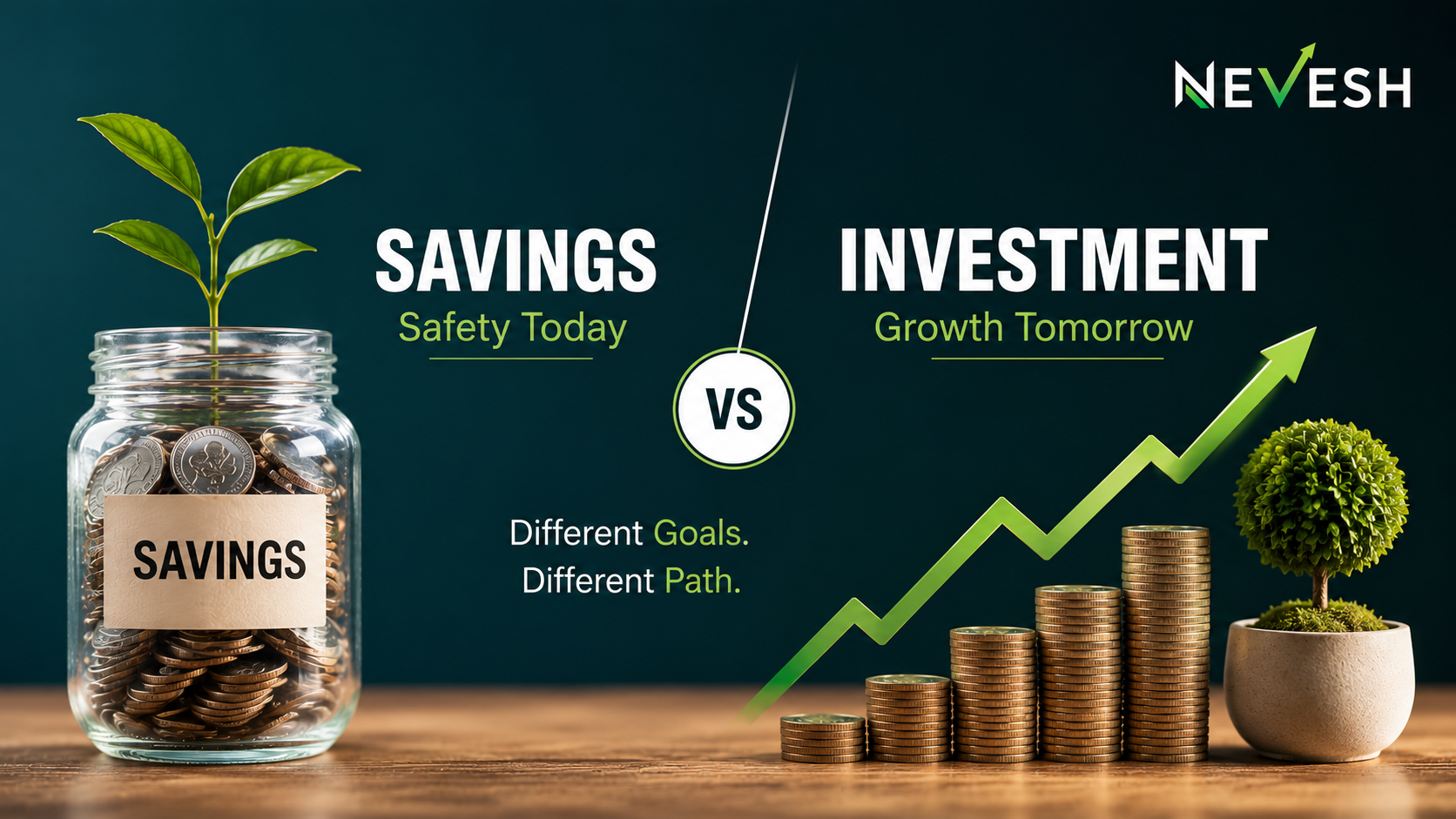
For many people, the two words feel interchangeable. Both involve money being “kept aside” for the future. But financially, they solve completely different problems. One protects your money. The other grows it. One gives you safety. The other gives you long-term wealth creation.
Understanding the difference is not just financial literacy. It changes how you make decisions about every salary credit, every SIP, every emergency expense, and every long-term goal.
Savings Protect Your Present. Investments Build Your Future.
Savings are the money you intentionally do not spend today. It is the buffer between you and financial stress.
When you keep money in a savings account, fixed deposit, recurring deposit, or emergency fund, your goal is usually stability and accessibility. You are not expecting dramatic returns. You are prioritising liquidity, certainty, and peace of mind.
Investments work differently. When you invest, you are accepting short-term uncertainty in exchange for long-term growth. You are putting your money into assets like mutual funds, stocks, bonds, ETFs, NPS, or even real estate with the expectation that they will appreciate over time.
This difference matters because too many investors try to use savings for wealth creation and investments for emergency liquidity. Both approaches create problems.
A savings account cannot realistically build retirement wealth because inflation slowly erodes purchasing power. At the same time, relying entirely on market investments without an emergency fund often forces people to withdraw during market corrections.
That is usually where emotional investing begins.
Why Indian Investors Often Lean Too Much Toward Savings
India has traditionally been a savings-first economy. For decades, families were taught that financial security meant fixed deposits, gold jewellery, LIC policies, and conservative money habits.
That mindset came from a genuine place. Earlier generations experienced unstable incomes, limited financial products, and less access to market-linked investments. Safety mattered more than growth.
Even today, RBI data shows Indian households continue allocating large portions of financial savings toward deposits and low-risk instruments. Meanwhile, mutual fund participation has grown rapidly only in the last decade, largely driven by SIP adoption and digital investing platforms. AMFI data shows that SIP contributions crossed record levels in 2025 and 2026, reflecting a major behavioural shift among younger investors.
But old habits still influence new investors.
A 28-year-old software engineer earning ₹18 lakh annually may still keep ₹10 lakh sitting idle in a savings account because “market risky hai.” Ironically, inflation quietly becomes the bigger risk over time.
At 6% inflation, the purchasing power of money roughly halves over 12 years. That means money sitting idle is not actually standing still. It is gradually becoming less valuable.
The Real Difference Is Behavioural, Not Mathematical
Most people think savings and investments differ only in risk and returns. The deeper difference is behavioural.
Savings reward caution. Investments reward patience.
Saving money feels emotionally comfortable because there is certainty. You know your ₹1 lakh will remain ₹1 lakh. Investing feels uncomfortable because market-linked assets fluctuate daily.
That emotional discomfort causes many investors to abandon long-term strategies midway.
Behavioural finance research by Barber and Odean famously showed that individual investors often underperform markets because they trade excessively and react emotionally. DALBAR studies over the years have repeatedly highlighted a similar pattern globally: investor behaviour often damages returns more than market volatility itself.
You can see this clearly during Indian market corrections.
When markets rise, investors suddenly become aggressive. Small-cap funds attract massive inflows. Social media becomes full of return screenshots. But during corrections, the same investors pause SIPs, redeem mutual funds, and move back to savings products.
The irony is difficult to ignore. Investors become most fearful precisely when long-term investing opportunities improve.
The Inflation Problem Most Savers Ignore
One of the biggest misconceptions around saving is believing your money is “safe” simply because the number in your account does not fall.
But inflation changes the equation completely.
Suppose you keep ₹5 lakh in a savings account earning 3% annually while inflation averages 6%. On paper, your money grows slightly every year. In reality, your purchasing power declines.
Ten years later, that ₹5 lakh may still look comforting on a banking app, but it will buy far less than it does today.
This is why long-term goals cannot rely only on savings.
Retirement planning, children’s education, buying a home, or building financial independence require assets capable of compounding meaningfully over decades. Historically, equities have outperformed inflation over long periods despite short-term volatility.
The Nifty and Sensex have experienced multiple crashes, corrections, and global crises. Yet over decades, disciplined investors who stayed invested through SIPs and diversified portfolios created substantial wealth.
The key phrase here is stayed invested.
A Simple Framework: When to Save and When to Invest
Many investors overcomplicate this decision. The framework itself is actually straightforward.
| Goal Type | Better Approach |
| Emergency fund | Savings |
| Rent, bills, near-term expenses | Savings |
| Vacation within 1–2 years | Savings or low-risk debt products |
| Buying a house in 10 years | Investments |
| Retirement planning | Investments |
| Child’s higher education | Investments |
| Wealth creation | Investments |
Your savings should protect your life from disruption.
Your investments should help you build the life you want later.
Trying to use one for both usually creates stress.
Tip Box
If your money will be needed within the next three years, prioritise safety over returns. If your goal is more than seven years away, inflation is a bigger threat than short-term market volatility.
Why SIPs Changed Investing Behaviour in India
The rise of SIPs has quietly transformed investing behaviour in India.
Earlier, investing felt intimidating because people believed they needed large lump sums or perfect market timing. SIPs changed the conversation from prediction to consistency.
A ₹5,000 monthly SIP feels psychologically manageable. More importantly, it removes decision fatigue.
You no longer need to ask:
“Is this the right market level?”
“Should I wait for a correction?”
“What if the market falls next month?”
The process becomes automatic.
This behavioural simplicity matters more than most investors realise. Good investing is often less about intelligence and more about reducing opportunities for emotional mistakes.
SEBI and AMFI have repeatedly highlighted how disciplined SIP investing improves long-term participation. During recent market volatility phases, SIP stoppage ratios remained lower than many expected, showing that Indian retail investors are gradually becoming more mature.
That shift matters.
A generation that learns to stay invested calmly through volatility may end up building far greater long-term wealth than previous generations that relied only on traditional savings products.
The Problem With Going “All In” on Investing
At the same time, there is another extreme emerging among younger investors.
Some people now treat savings as unnecessary. Every rupee goes into equities, crypto, thematic funds, or aggressive investments.
This usually works until life becomes unpredictable.
A job loss, medical emergency, family obligation, or sudden expense can force investors to liquidate investments during market declines. That is financially damaging and emotionally exhausting.
Your emergency fund is not supposed to generate high returns. Its job is stability.
Think of it like carrying an umbrella in Mumbai during monsoon season. You hope you do not need it. But when you do, nothing else matters more.
Financial Confidence Comes From Balance, Not Extremes
The healthiest financial systems are rarely built on extremes.
Pure savers often struggle to outpace inflation. Pure investors often struggle during emergencies and market stress.
Balanced financial behaviour usually looks more sustainable:
- Maintain an emergency fund covering 6–12 months of expenses.
- Use savings products for short-term goals.
- Invest consistently for long-term goals.
- Increase SIPs as income rises.
- Avoid reacting emotionally to market movements.
This sounds simple because it is simple.
The difficulty lies in behaviour, not complexity.
The market constantly tempts people toward action. Every correction feels like a crisis. Every rally feels like an opportunity you are missing.
Calm investors generally perform better because they avoid unnecessary decisions.
Why Simplicity Often Wins
There is a strange belief in personal finance that sophisticated strategies automatically create better outcomes.
But many financially successful investors simply follow boring systems consistently for years.
They maintain emergency funds.
They invest monthly.
They avoid excessive debt.
They stay invested through volatility.
They increase investments gradually as income grows.
That discipline compounds quietly over time.
Meanwhile, investors chasing “perfect” investment strategies often keep changing direction before compounding can actually work.
The most powerful wealth-building behaviour is consistency.
The Nevesh View Point
At Nevesh, we believe financial success is less about finding the “best” investment and more about building the right behaviour around money.
The smartest investors are rarely the loudest. They are usually the calmest. They understand that savings create stability, investments create growth, and discipline creates long-term wealth.
Most financial mistakes do not happen because people lack information. They happen because emotions interrupt good decisions. That is why investing should feel simple, sustainable, and emotionally manageable.
The goal is not to constantly optimise your portfolio. The goal is to build a financial system you can stick with for decades.
FAQs
Should I save money before I start investing?
Yes. Building an emergency fund should usually come before aggressive investing. Ideally, you should have at least 6 months of essential expenses available in liquid savings before increasing exposure to market-linked investments.
Is keeping money in a savings account enough for long-term goals?
Usually not. Savings accounts offer safety and liquidity, but their returns often struggle to beat inflation over long periods. Long-term goals like retirement or children’s education generally require investments capable of compounding meaningfully.
How much should I keep in savings versus investments?
There is no universal ratio because it depends on your income stability, goals, dependents, and risk comfort. A common approach is maintaining emergency savings separately while investing surplus income regularly through SIPs and diversified portfolios.
Are SIPs better than fixed deposits?
They serve different purposes. Fixed deposits prioritise capital protection and provide predictable returns. SIPs invest in market-linked mutual funds and aim for long-term growth. Comparing them directly is like comparing an umbrella to a raincoat. Both solve different problems.
What is the biggest mistake first-time investors make?
Many first-time investors either delay investing for too long or invest aggressively without building financial stability first. Another common mistake is reacting emotionally during market corrections and stopping SIPs midway.
Risk Disclaimer: This article is intended for educational purposes only and should not be considered investment advice. Investments in mutual funds and market-linked instruments are subject to market risks. Please read all scheme-related documents carefully and consult a qualified financial advisor before making investment decisions.