

Nevesh | September 2026
For years, India’s petcare market was treated as a small corner of consumer spending.
A bag of dog food. A neighbourhood veterinarian. Perhaps a grooming appointment once in a while.
That model is changing.
Urban pet owners are increasingly behaving less like owners and more like parents. They are spending on specialised nutrition, healthcare, diagnostics, grooming, medicines and increasingly, convenience.
For startups, that shift has created a tempting opportunity.
But building a business around pet parents is very different from simply selling pet food online.
That is the challenge facing Supertails.
The Bengaluru-based petcare startup is targeting revenue of ₹200 crore in FY26 and has laid out plans to build more than 100 dark stores and 100 veterinary clinics over the next three years. The longer-term ambition is even larger: building a ₹1,000 crore petcare business.
The company is attempting to combine digital commerce, rapid delivery, veterinary healthcare, physical clinics, grooming, diagnostics, pharmacy and private-label products into one ecosystem.
On paper, the opportunity is compelling.
But the difficult part begins after that.
Supertails is no longer simply trying to prove that Indians will spend money on their pets.
It now has to prove that an integrated petcare business, with warehouses, doctors, clinics and technology, can eventually become financially sustainable.
That distinction matters.
The Business Behind Supertails
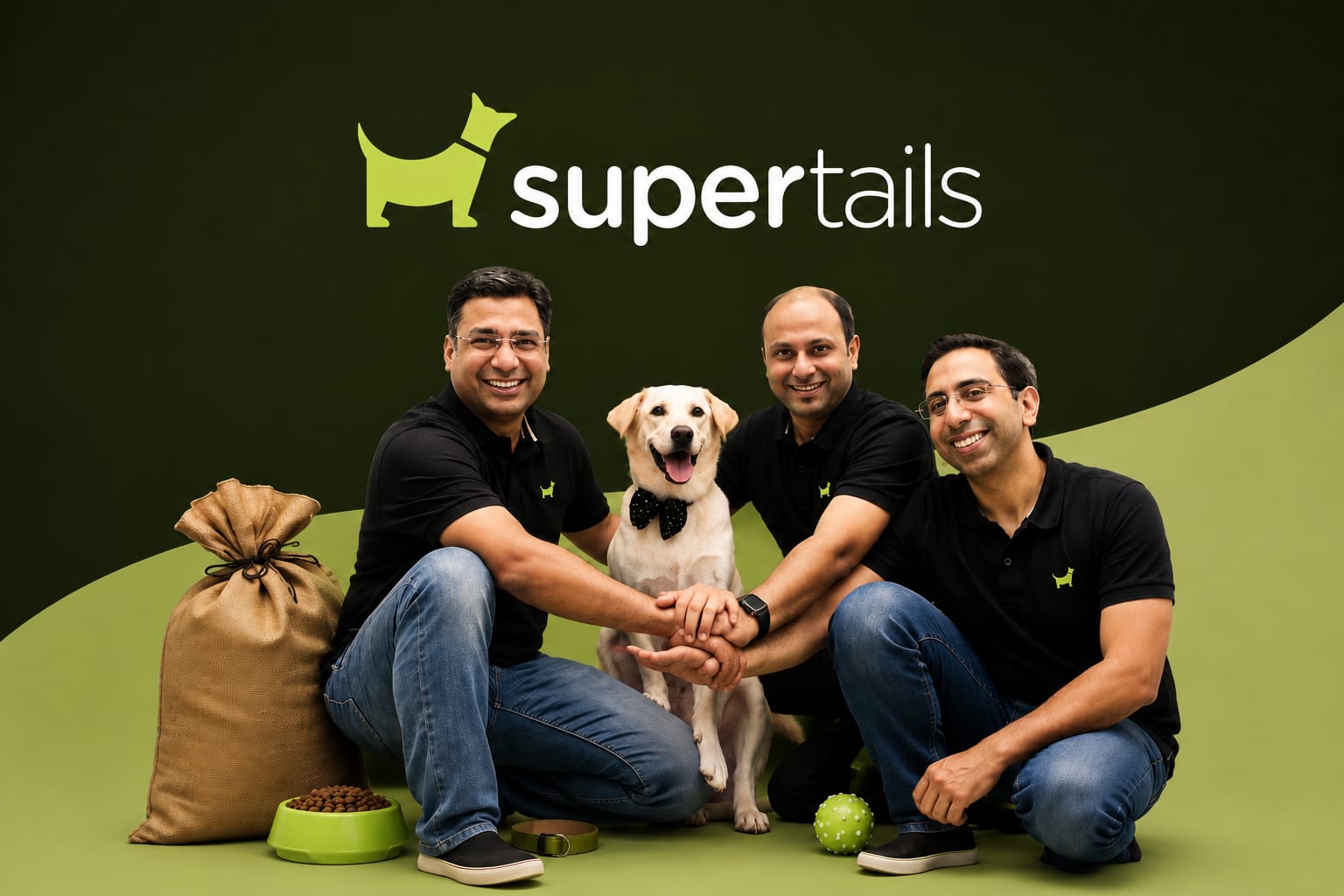
Supertails was founded in 2021 by Varun Sadana, Aman Tekriwal and Vineet Khanna.
The company’s original proposition was relatively straightforward: make pet parenting easier by bringing products, information and veterinary support onto one platform.
But Supertails has gradually expanded far beyond an e-commerce marketplace.
Today, its business spans pet food and accessories, online veterinary consultations, physical veterinary clinics, at-home services, grooming, diagnostics, pharmacy and rapid delivery.
The company has also entered private-label products with brands such as Henlo, Skatrs and Scoopy.
That makes Supertails a very different business from a traditional pet food company.
It is also different from a conventional online marketplace.
Supertails is trying to own multiple parts of the petcare journey.
A customer could theoretically discover the company while searching for pet food, speak to a veterinarian through its platform, visit one of its clinics, buy medicines, book grooming and eventually purchase private-label nutrition products.
This is where the business becomes interesting.
The company is not merely chasing transactions.
It is trying to build a long-term relationship with the pet parent.
And in pet care, that relationship could potentially become more valuable over time.
Why India’s Petcare Market Matters Now
The biggest change in India’s pet economy is behavioural.
Pets are increasingly being treated as family members.
That changes how consumers spend.
A consumer who sees a pet primarily as an animal may purchase food and basic healthcare.
A consumer who sees a pet as a family member is more likely to spend on premium nutrition, preventive healthcare, diagnostics, specialised products and professional services.
That shift is creating a larger commercial opportunity.
India’s petcare market is still fragmented, particularly when it comes to organised healthcare and integrated services.
Consumers can find pet food online.
They can visit local veterinarians.
They can book grooming.
But these services have traditionally operated separately.
Supertails is betting that the future of the category will be more organised.
Its strategy is built around bringing those fragmented services together.
The timing may also be working in its favour.
The company’s latest expansion plans suggest that demand is increasingly broad enough to support rapid delivery and specialised healthcare infrastructure across multiple cities. Supertails currently operates 45 dark stores across Bengaluru, Delhi and Mumbai and 12 veterinary clinics in Bengaluru, according to its August 2026 expansion update.
The company is now targeting cities including Pune, Chennai, Hyderabad and Kolkata.
The question is whether demand is developing quickly enough to support the infrastructure required to serve it.
Supertails Is Building More Than an Online Pet Store
The company’s strategy can be divided into three businesses.
The first is commerce.
Supertails sells pet food, treats, accessories, medicines and other products through its platform.
The second is healthcare.
This includes veterinary consultations, clinics, diagnostics, treatment and related services.
The third is convenience.
Its dark stores are designed to support rapid delivery of pet products.
Each business solves a different problem.
Commerce creates frequency.
Healthcare creates trust.
Convenience creates habit.
The strategy makes sense on paper because these businesses can feed into one another.
A customer visiting a Supertails clinic could purchase medicines and nutrition products through the platform.
A customer buying pet food regularly could eventually use Supertails for healthcare.
A veterinary consultation could potentially lead to repeat purchases of recommended products.
This is the ecosystem Supertails is trying to build.
But ecosystems are expensive.
And that is where the financial story becomes more complicated.
The ₹200 Crore Target Is Ambitious. The Economics Will Matter More.
Supertails expects revenue to reach ₹200 crore in FY26.
The company has also spoken about annual growth of between 80% and 100% as it expands its operations.
That growth ambition follows a strong FY25.
According to financial statements analysed by Entrackr, Supertails reported revenue from operations of ₹108.3 crore in FY25, up 68% from ₹64.6 crore in FY24.
There is, however, another side to those numbers.
The company’s losses widened.
Entrackr reported that Supertails’ losses increased 28% to ₹52.5 crore in FY25, while overall expenses reached ₹165.8 crore. The company reportedly spent ₹1.53 for every ₹1 of revenue generated during the year.
This does not automatically mean the business is failing.
Rapidly growing startups often lose money while expanding infrastructure and acquiring customers.
But it does create an important question.
Can Supertails grow its revenue without costs continuing to rise at the same speed?
That is the central business question.
The company has previously described itself as operationally profitable, while statutory financial data for FY25 showed significant net losses. These are not necessarily the same measurement, but readers and investors should understand the difference between operational metrics and reported profitability.
For Supertails, the next stage will require more than growth.
It will require better economics.
Why Dark Stores Are Both an Opportunity and a Risk
Supertails currently operates 45 dark stores across Bengaluru, Delhi and Mumbai.
The company plans to expand to more than 100 dark stores over the next three years.
The logic is understandable.
Petcare is a repeat-purchase category.
Food runs out.
Cat litter needs replenishing.
Medicines need refilling.
Treats and other essentials are purchased regularly.
That creates the kind of recurring demand that can make quick delivery attractive.
But quick delivery is not automatically profitable.
Dark stores require inventory, warehouses, logistics and operational teams.
The economics only begin to work when order density becomes high enough.
A 30-minute delivery is useful to the consumer.
The question is whether the customer is willing to pay for that convenience or whether Supertails will have to absorb the cost.
This is where the dark store strategy will be tested.
The company does not necessarily need every product to arrive in 30 minutes.
Emergency medicines are different from a monthly food order.
A successful logistics strategy may depend on knowing when speed matters and when it does not.
The company will need to build efficiency rather than simply chase faster delivery.
The Bigger Bet Is on Veterinary Healthcare
Supertails’ dark stores may improve convenience.
Its clinics could potentially create something more valuable.
Trust.
Healthcare is difficult to scale.
It requires doctors, diagnostics, equipment, infrastructure and consistent quality.
That makes veterinary clinics much harder to replicate than an e-commerce platform.
Supertails currently operates 12 veterinary clinics in Bengaluru and plans to build more than 100 clinics over the next three years.
The company has said that its veterinary centres operate as multi-speciality facilities offering consultations, diagnostics, surgeries, emergency care, inpatient treatment, grooming and retail.
Each clinic reportedly requires between ₹60 lakh and ₹1 crore in investment.
That makes this part of the business capital-intensive.
But it could also become Supertails’ strongest competitive advantage.
An online marketplace can be replicated.
A national veterinary healthcare network cannot be built overnight.
The real question is whether the economics justify the investment.
A clinic has to generate enough revenue not only to cover doctors and infrastructure but also to create additional value for the broader ecosystem.
If clinic customers begin buying medicines, food and other products through Supertails, the economics could improve.
If each business operates independently, the company could simply end up managing multiple expensive businesses under one brand.
That distinction will determine whether the ecosystem becomes an advantage or a burden.
The Cat Care Opportunity Could Be Bigger Than It Looks
One of the more interesting aspects of Supertails’ growth story is the importance of cats.
According to the company’s recent disclosures, cats account for roughly 15% of India’s pet population but contribute nearly 60% of Supertails’ revenue.
The company also believes the cat care segment is growing faster than the broader petcare market.
That may explain why Supertails is expanding its private-label nutrition portfolio and plans to launch Henlo cat food.
The opportunity is worth watching.
The cat category is still smaller than the dog category in India, but smaller markets can grow quickly when consumer behaviour changes.
Cat owners also tend to have specific requirements around nutrition, litter, grooming and healthcare.
For Supertails, this could create a valuable repeat-purchase category.
But there is another question.
Can the company turn its early strength in cat care into a defensible business advantage?
Large consumer companies are increasingly looking at India’s petcare market.
If the category becomes large enough, competition will increase.
Supertails will need more than an early lead.
It will need customer loyalty.
Private Labels Could Change the Business Economics
Marketplace businesses have a structural problem.
They can generate significant revenue while retaining relatively modest margins.
Private labels can change that equation.
Supertails’ in-house brands, including Henlo, Skatrs and Scoopy, currently contribute between 6% and 8% of overall revenue, according to the company’s August update.
That number is still relatively small.
But strategically, private labels could become much more important.
A successful private-label portfolio gives the company greater control over products, pricing and margins.
It can also create stronger customer loyalty.
The difficult part is trust.
Pet food is not like buying a new snack brand.
Pet parents can be cautious about changing their animal’s diet.
A company needs to convince customers that the product is safe, consistent and appropriate.
This is where Supertails’ integrated model could help.
Healthcare and expert guidance could potentially strengthen customer confidence in the company’s nutrition products.
But the company will need to handle that carefully.
Trust built through healthcare can be powerful.
It can also be damaged quickly.
Why Investors Are Paying Attention
In February 2026, Supertails raised $30 million in a Series C funding round led by Venturi Partners.
The round also included Nippon India Alternative Investments, Titan Capital Winners Fund and existing investors Fireside Ventures, RPSG Capital Ventures, Sauce VC and Saama Capital.
The funding is intended to support expansion across clinics, veterinary services, technology, personalisation and fulfilment.
That investment suggests that Supertails’ backers are not simply betting on pet food sales.
They are betting on the creation of an organised petcare infrastructure business.
Venturi Partners has invested in several consumer-focused businesses, and Supertails fits a familiar investment thesis.
Large consumer categories often become valuable when fragmented markets are organised through better brands, distribution and customer experience.
Petcare could be one such category.
But raising money gives a startup the opportunity to build.
It does not prove that the business has already succeeded.
Supertails has now raised significant capital.
The real test is what the company builds with it.
The Founders’ Challenge Is No Longer About Identifying the Opportunity
Supertails was founded by Varun Sadana, Aman Tekriwal and Vineet Khanna.
The founders identified an early problem in the Indian petcare market.
First-time pet parents often needed more than products.
They needed advice and support.
That insight helped shape Supertails into a broader platform rather than a conventional online store.
The company’s next challenge is very different.
Identifying the opportunity is no longer the difficult part.
Execution is.
The founders now have to manage a business operating across technology, e-commerce, logistics, healthcare and physical infrastructure.
Each of these requires a different operating capability.
The company will have to recruit and retain veterinary professionals.
It will have to manage clinic operations.
It will need to control logistics costs.
It will need to build brands.
And it will need to expand into new cities without compromising customer experience.
This is no longer a startup operating from a single playbook.
It is becoming a multi-layered consumer and healthcare business.
The Difficult Questions Start Now
The funding announcement is encouraging.
It is not yet proof of a successful business.
Supertails‘ biggest challenge will be profitability.
The company has demonstrated revenue growth.
The question is whether the expansion strategy can eventually produce operating leverage.
Opening more clinics requires capital.
Opening more dark stores requires capital.
Entering more cities requires capital.
Building private labels requires capital.
The company will therefore have to demonstrate that each additional investment makes the overall ecosystem stronger.
There is also competition.
The Indian petcare category is becoming increasingly attractive to startups, consumer companies and specialised veterinary businesses.
Supertails may have built an early advantage by combining multiple services.
But being first does not guarantee long-term leadership.
The company will also have to solve the complexity problem.
Building one successful business is difficult.
Building several connected businesses simultaneously is harder.
The biggest question is no longer whether Supertails can build the product or attract customers.
It is whether it can build a repeatable business around an increasingly complex ecosystem.
What Should We Watch Next?
The next few years will provide clearer answers.
Can Supertails reach ₹200 crore in FY26?
The company’s revenue target will be the first major indicator of whether its expansion strategy is translating into growth.
Do losses begin to narrow?
Revenue growth will matter.
But improving unit economics will matter more.
Can the clinics become financially efficient?
The clinic business could become Supertails’ strongest moat.
It could also become its largest cost centre.
Does rapid delivery improve customer retention?
The company needs to prove that dark stores create profitable repeat behaviour rather than simply faster delivery.
Can private labels become a larger part of the business?
Brands such as Henlo could eventually improve margins and strengthen customer loyalty.
Can Supertails successfully expand beyond Bengaluru?
The company’s ability to replicate its model across multiple cities will reveal whether the business is genuinely scalable.
The Nevesh View Point
Supertails is interesting not because it raised $30 million.
It is interesting because it is attempting to build infrastructure around a consumer behaviour that is still evolving.
The company has recognised something important.
Petcare is not a single transaction.
It is a relationship that can last for years.
A pet needs food repeatedly.
It needs healthcare.
Sometimes emergency treatment.
Sometimes grooming.
Sometimes medicines.
That creates the possibility of building a high-frequency consumer ecosystem.
But ecosystems are easy to describe and difficult to operate.
Supertails is betting that its different businesses will reinforce one another.
The clinics will create trust.
Trust will increase commerce.
Commerce will generate repeat behaviour.
Private labels will improve margins.
Technology will improve personalisation.
Dark stores will improve convenience.
If that cycle begins to work, Supertails could build a significant advantage in India’s petcare market.
But if each vertical continues to require separate investment without producing enough cross-selling or operating leverage, the company could find itself managing an increasingly expensive collection of businesses.
The real test begins now.
Supertails has identified the opportunity.
It has raised the capital.
It has started building the infrastructure.
The next challenge is proving that all those pieces can work together as a business.
The Road to ₹1,000 Crore
A ₹1,000 crore business is an ambitious target.
India’s growing pet population and changing consumer behaviour give Supertails a large market to pursue.
But the company cannot reach that scale simply by opening more locations.
Scale without improving economics can create larger problems.
Supertails will need to demonstrate that its model becomes stronger as it grows.
That means more repeat customers.
Better clinic utilisation.
Higher private-label adoption.
Efficient logistics.
Improving margins.
And eventually, profitability.
The petcare opportunity is real.
The customer behaviour is changing.
The funding is available.
The infrastructure is being built.
The question that remains is much harder.
Can Supertails turn India’s growing love for pets into a business that scales without the costs of that growth eventually catching up with it?
That will determine whether Supertails becomes a ₹1,000 crore petcare platform.
Or simply another well-funded startup that grew faster than its economics.
FAQs
What does Supertails do?
Supertails is an integrated petcare platform that combines pet product commerce with healthcare and services. The company offers pet food, treats, accessories, medicines, veterinary consultations, physical clinics, diagnostics, grooming and at-home veterinary services. Founded in 2021, Supertails is trying to build an end-to-end ecosystem for Indian pet parents rather than operating only as an online pet products marketplace. Its business model combines recurring product purchases with healthcare and service offerings.
Who founded Supertails?
Supertails was founded by Varun Sadana, Aman Tekriwal and Vineet Khanna. The founders built the company around the idea that Indian pet parents, particularly first-time pet parents, needed more than access to products. They also needed guidance, healthcare support and reliable services. That thinking shaped Supertails into an integrated petcare platform spanning digital commerce, veterinary care, clinics and other services.
How much revenue is Supertails targeting in FY26?
Supertails is targeting approximately ₹200 crore in revenue in FY26. The company is pursuing this growth through expansion in rapid delivery, dark stores, veterinary clinics and private-label products. Its longer-term ambition is to build a ₹1,000 crore petcare business. The company is planning to expand its network to more than 100 dark stores and more than 100 veterinary clinics over the next three years.
How much funding has Supertails raised?
Supertails raised $30 million in its Series C funding round in February 2026, led by Venturi Partners. The round also included Nippon India Alternative Investments, Titan Capital Winners Fund and existing investors including Fireside Ventures, RPSG Capital Ventures, Sauce VC and Saama Capital. Publicly reported funding totals vary depending on the treatment of previous rounds and financing, but the latest Series C was one of the company’s largest reported funding rounds.
Is Supertails profitable?
Supertails’ FY25 financial performance shows strong growth alongside continuing losses. According to financial statements analysed by Entrackr, the company’s revenue from operations rose 68% to ₹108.3 crore in FY25, while losses widened 28% to ₹52.5 crore. The company has separately described itself as operationally profitable, highlighting the difference between company-reported operational metrics and statutory profitability measures. Investors and business watchers should therefore track future financial filings to understand whether the company’s expansion is improving overall economics.
Why is Supertails investing in veterinary clinics?
Veterinary clinics are a major part of Supertails’ strategy to build an integrated petcare ecosystem. Healthcare can help the company establish deeper and longer-term relationships with pet parents while creating opportunities for diagnostics, pharmacy, nutrition and other services. The company currently operates veterinary clinics in Bengaluru and plans significant expansion over the next three years. The challenge is that clinics are capital-intensive and operationally complex, meaning the company will need to demonstrate that healthcare infrastructure can generate sustainable returns.
What should investors and industry watchers watch next?
The most important indicators will be revenue growth, profitability, clinic utilisation, repeat customer behaviour and the economics of the dark store network. Supertails’ ability to grow private-label brands will also be important because private labels could potentially improve margins. More broadly, the company will need to prove that its different businesses strengthen one another. The success of its strategy will depend on whether healthcare, commerce and rapid delivery can create operating leverage instead of simply increasing operational complexity.
Risk Disclaimer
This article is for informational and editorial purposes only and should not be considered investment advice. Startup and private-company investments involve significant risks, and future business performance cannot be guaranteed. Readers should independently verify financial and business information before making investment or commercial decisions.