

Most people don’t ignore risk on purpose. They simply don’t think about it until something goes wrong.
When choosing a mutual fund, investors usually compare returns, ratings and rankings. A fund that has delivered impressive performance over the last three or five years naturally grabs attention. Friends recommend it, finance influencers talk about it, and online platforms highlight it. Amid all this information, one small section on the factsheet often goes unnoticed.
That section is the Riskometer.
It doesn’t promise high returns or predict future performance. Instead, it tells you how much risk the scheme is expected to carry. Surprisingly, this is one of the most valuable pieces of information available before investing, yet it is also one of the least understood.
Many investors assume all equity funds are equally risky and all debt funds are equally safe. That belief can lead to poor decisions because risk varies widely even within the same category of mutual funds.
Looking only at returns is like buying a car based solely on its top speed while ignoring its safety features. The excitement is easy to appreciate, but the risks become obvious only when conditions change.
The Riskometer encourages investors to pause before making that decision. Instead of asking, “How much can I earn?”, it quietly asks, “How much uncertainty am I comfortable accepting?”
Why Most Investors Think About Risk Only After Markets Fall
Investor behaviour often changes with market conditions.
When stock markets are rising, risk rarely becomes part of the conversation. Investors become more confident, SIPs increase, and funds that once seemed aggressive suddenly appear perfectly reasonable. Strong returns create the impression that higher risk is always rewarded.
Then markets correct.
A fall of ten or fifteen percent is enough to change the mood completely. Investors who were comfortable taking risks only a few months earlier begin searching for safer options. Some stop their SIPs. Others redeem their investments even though their long-term goals remain unchanged.
Interestingly, the mutual fund itself may not have changed much. The portfolio could be broadly the same. What changes is the investor’s comfort level.
Behavioural finance explains this through loss aversion. Most people feel the pain of losing money far more intensely than the happiness of making the same amount. A temporary fall in portfolio value often creates emotional pressure that outweighs years of steady gains.
This is where the Riskometer becomes useful. It prepares investors for the journey before they begin. If you understand that a fund is expected to experience volatility, you are less likely to panic when markets behave exactly as they should.
What Exactly Is a Mutual Fund Riskometer?
The Riskometer is a standard risk indicator used by mutual funds in India. Every scheme is required to display it in its Scheme Information Document, Key Information Memorandum and other official communication.
Its purpose is straightforward. It gives investors a quick indication of the level of risk associated with a mutual fund scheme without requiring them to study every security held in the portfolio.
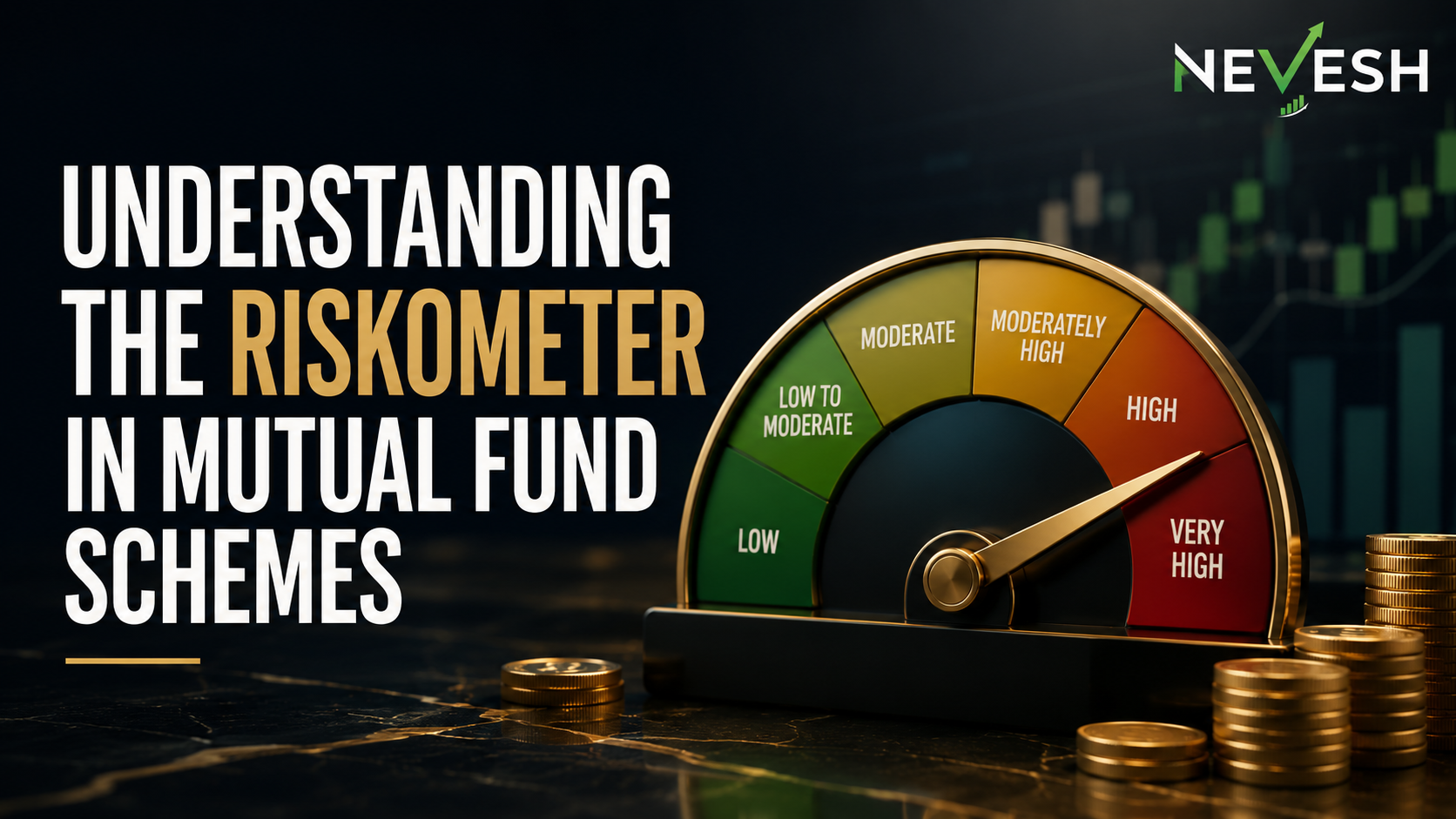
The Riskometer currently classifies schemes into six broad categories.
- Low Risk
- Low to Moderate Risk
- Moderate Risk
- Moderately High Risk
- High Risk
- Very High Risk
These categories are determined by the nature of the investments held by the fund. Factors such as equity exposure, credit quality, duration and portfolio composition all influence where a scheme falls on the Riskometer.
A large-cap equity fund, for example, is generally more stable than a small-cap fund. Even so, it is still likely to be classified as Very High Risk because equity investing carries significant market risk.
Similarly, debt funds are not automatically low risk. A debt scheme investing in lower-rated bonds carries different risks from one investing primarily in government securities.
The Riskometer reflects these differences, helping investors understand that risk is not determined by the product label alone.
Returns Can Be Misleading Without Understanding Risk
Investors naturally like comparing returns. It is simple, familiar and easy to measure.
The problem is that returns tell only one part of the story.
Imagine two mutual funds that have generated similar five-year returns. On paper, they appear almost identical. Yet one fund may have achieved those returns with relatively stable performance, while the other may have experienced sharp ups and downs along the way.
Without considering risk, both funds appear equally attractive.
This is why experienced investors rarely judge a scheme by returns alone. They also consider the amount of uncertainty involved in earning those returns.
The Riskometer provides useful context. It reminds investors that higher returns often come with greater fluctuations and that every investment carries a different level of uncertainty.
Instead of chasing whichever fund topped the performance chart last year, investors can make decisions that are more consistent with their financial goals and emotional comfort.
Risk Does Not Stay the Same Forever
Many investors check the Riskometer before investing and never look at it again.
That can be a mistake.
Mutual fund portfolios change over time. Fund managers may alter asset allocation, increase exposure to certain sectors or change the quality of debt instruments held within the portfolio. As these changes happen, the overall risk profile of the scheme may also change.
For this reason, the Riskometer is reviewed periodically.
This does not mean investors should keep switching funds every few months. It simply means that reviewing your portfolio from time to time is a sensible habit. A fund that suited your financial goals three years ago may not be the perfect fit today if your circumstances or investment objectives have changed.
Monitoring risk should be part of a regular portfolio review rather than something investors think about only during market corrections.
Matching the Riskometer With Your Financial Goal
Choosing the right mutual fund is not about finding the highest return or the lowest risk.
It is about finding the right balance.
Someone investing for retirement twenty or thirty years away can usually tolerate much larger market fluctuations than someone saving for a home purchase next year.
Likewise, parents investing for a child’s education may gradually reduce portfolio risk as the goal approaches. The investment strategy changes because the financial objective changes.
Before investing in any mutual fund, ask yourself one simple question.
“If this investment falls sharply over the next few months, will I still be comfortable remaining invested?”
There is no universal answer.
Your age, financial responsibilities, income stability, emergency savings and investment horizon all influence how much risk is appropriate.
Many investors discover their actual risk tolerance only after markets decline. By then, emotional decisions often replace rational ones.
Understanding your own comfort level before investing is just as important as understanding the mutual fund itself.
Common Misconceptions About the Riskometer
One misunderstanding about the Riskometer is that a scheme marked “Very High Risk” should always be avoided. That is not what the label means. It simply tells you that the fund is exposed to a higher level of market risk compared to other categories.
Most equity mutual funds, including large-cap funds, fall into the Very High Risk category because stock prices fluctuate over time. That doesn’t make them unsuitable investments. For someone investing through SIPs for retirement or another long-term goal, such funds may actually be the right choice.
Another common belief is that low-risk funds cannot lose money. While debt funds and liquid funds usually experience lower volatility than equity funds, they are not risk-free. Interest rate movements, credit events and liquidity issues can still affect their returns. The difference is that these risks are generally lower than those associated with equity investments.
Some investors also assume that if a fund has delivered strong returns in recent years, taking additional risk is automatically worthwhile. Markets rarely work that way. A fund’s past performance reflects a specific period and a particular market environment. It should never be viewed as a guarantee of future returns.
Understanding Risk Across Different Mutual Fund Categories
The Riskometer becomes more meaningful when you understand how different mutual fund categories are structured.
Equity funds usually carry the highest level of risk because they invest in shares of listed companies. Within this category, large-cap funds are generally less volatile than mid-cap or small-cap funds. Sectoral and thematic funds often experience even sharper price swings because they focus on a limited segment of the market.
Debt funds are comparatively stable, but they are not identical. A short-duration debt fund behaves differently from a long-duration debt fund. Similarly, a fund investing in high-quality government securities carries a different level of risk than one investing in lower-rated corporate bonds.
Hybrid funds combine equity and debt in different proportions. Conservative hybrid funds generally carry lower risk because they allocate more money to fixed-income securities. Aggressive hybrid funds, with a higher equity allocation, naturally carry greater market risk.
Passive investments such as Index Funds and ETFs also display a Riskometer. Since they simply track an index, some investors assume they are low risk. In reality, their risk depends entirely on the index they follow. A Nifty 50 Index Fund has a very different risk profile from a Small Cap Index Fund.
The category of the fund is only one part of the picture. The assets inside the portfolio determine the actual level of risk.
Risk and Volatility Are Not the Same
The terms “risk” and “volatility” are often used interchangeably, but they describe different things.
Volatility refers to the movement in the value of an investment. Equity markets rise, fall and recover over time. Those fluctuations are normal and should be expected.
Risk goes beyond day-to-day price movements. It includes the possibility of failing to achieve your financial goal, losing capital permanently, investing in poor-quality securities or being forced to withdraw money during an unfavourable market phase.
Consider two investors.
One is investing for retirement twenty-five years away. The other is saving for a house purchase next year.
Both choose the same equity fund.
If markets decline sharply, the long-term investor still has enough time to recover. The second investor may be forced to postpone an important financial goal.
The investment is the same, but the level of risk is very different because their objectives are different.
The Riskometer helps investors think beyond temporary market movements and focus on whether the investment suits the purpose for which it is being made.
Using the Riskometer as Part of a Bigger Picture
The Riskometer should never be the only reason to invest in or reject a mutual fund. It works best when combined with other important factors such as your investment horizon, financial goals and asset allocation.
Before investing, ask yourself a few practical questions.
What is this money meant for?
How long can I remain invested?
Will I be comfortable if the investment falls by twenty percent?
Do I already have enough exposure to similar funds?
Simple questions like these often provide better guidance than chasing last year’s best-performing scheme.
Diversification also deserves attention. Equity, debt, gold and other asset classes serve different purposes within a portfolio. A well-diversified portfolio can reduce the impact of market volatility without giving up long-term wealth creation.
Investors who review their portfolio periodically are usually better prepared for changing market conditions than those who focus only on returns.
The Nevesh View Point
Many investors believe managing risk means avoiding volatility.
It doesn’t.
Managing risk means understanding what you own and knowing why you own it.
A Riskometer cannot tell you whether a mutual fund will generate the highest returns over the next five years. It cannot predict market corrections or identify the next winning sector. What it does exceptionally well is remind you that every investment carries a certain level of uncertainty.
The biggest inveshttps://investor.sebi.gov.in/ting mistakes rarely happen because people choose the wrong mutual fund. They happen because investors choose funds that don’t match their expectations. They expect equity funds to behave like fixed deposits, or they invest for long-term goals with money they may need in the short term.
Good investing starts with self-awareness.
When your investments match your financial goals and your ability to stay invested, market volatility becomes easier to handle. The Riskometer is not simply measuring the risk of a mutual fund. It is helping you understand whether the investment fits your own financial journey.
Frequently Asked Questions
Is a Very High Risk mutual fund unsuitable for beginners?
Not at all. A beginner with a stable income, a long investment horizon and realistic expectations can invest in a Very High Risk equity fund through SIPs. What matters more than experience is understanding that market fluctuations are normal. Investors who expect steady returns from equity funds often panic during corrections. Those who understand volatility are more likely to remain invested and benefit from long-term compounding.
Can the Riskometer of a mutual fund change after I invest?
Yes. Mutual fund houses review the risk profile of their schemes periodically. Changes in asset allocation, portfolio composition, interest rate exposure or credit quality can result in a different Riskometer classification. Reviewing your investments once or twice a year helps ensure they continue to align with your financial goals and risk tolerance.
Should I avoid funds with higher risk?
Not necessarily. A higher-risk fund is suitable when it matches your investment objective and time horizon. Long-term goals such as retirement usually allow investors to take more market risk than short-term goals like building an emergency fund or saving for a vacation. The objective should always determine the level of risk you are willing to accept.
Does the Riskometer guarantee future performance?
No. The Riskometer indicates the level of risk associated with a scheme based on its current portfolio. It does not predict returns or guarantee future performance. Even a lower-risk fund can outperform a higher-risk fund during certain periods, while a higher-risk fund may underperform despite carrying greater market exposure.
Is a debt fund always safer than an equity fund?
Debt funds generally experience lower volatility than equity funds, but they are not free from risk. Interest rate changes, liquidity concerns and credit quality can all influence their performance. Investors should understand the type of debt fund they are investing in instead of assuming every debt fund offers the same level of safety.
How often should I check the Riskometer?
Checking the Riskometer once or twice a year is sufficient for most long-term investors. You should also review it whenever your financial goals change or when you plan to invest a significant additional amount. Regular reviews are helpful, but monitoring it every week or every month is usually unnecessary.
Risk Disclaimer
Mutual fund investments are subject to market risks. Past performance does not guarantee future results. Investors should read all scheme-related documents carefully before investing. This article is meant purely for educational purposes and should not be treated as personalised investment advice. Always consider your financial goals, investment horizon and risk tolerance, or consult a qualified financial advisor before making any investment decision.
[…] Did the fund manager take unnecessary risks? […]