

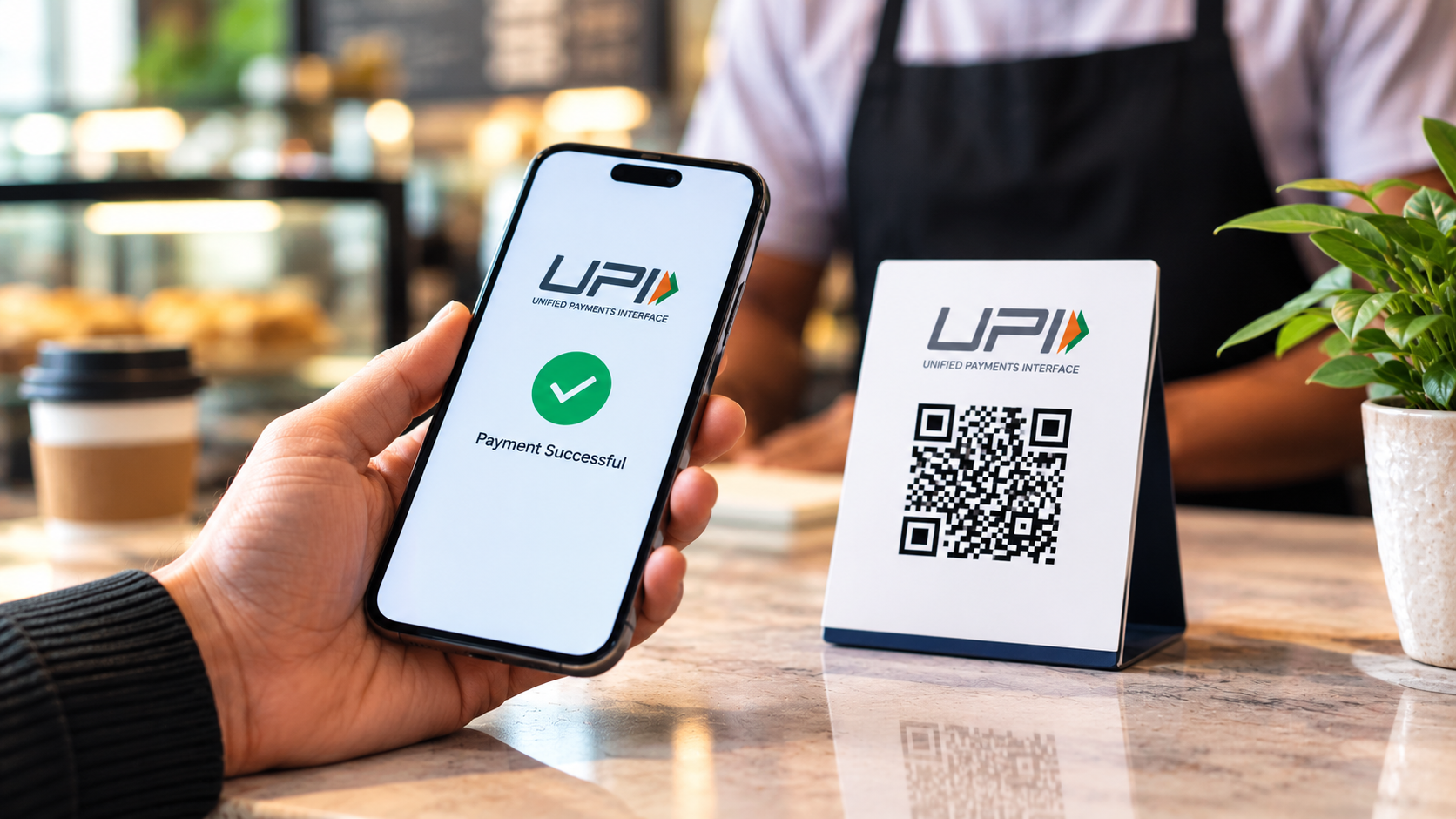
India’s UPI system is changing, but not in the way several viral messages have suggested.
From October 15, 2026, selected UPI payments above ₹2,000 will come under a new Merchant Discount Rate (MDR) framework. The change has already triggered questions among consumers: Will sending money to family now cost more? Will a ₹5,000 UPI payment attract a fee? And will payment apps such as PhonePe and Google Pay start charging users?
The answer, according to the government, is no for ordinary person-to-person payments.
The new framework distinguishes between money sent from one individual to another and payments made to merchants. Person-to-person UPI transactions will remain completely free, irrespective of the amount transferred.
The distinction matters because the ₹2,000 threshold applies to certain person-to-merchant (P2M) transactions, not to every UPI transfer.
What changes from October 15
Under the framework announced by the government, a 0.4% MDR will apply to specified merchant UPI transactions above ₹2,000. For transactions of ₹75,000 and above, the charge will be capped at ₹300 per transaction.
MDR, however, is not a charge that the customer is supposed to pay.
It is a fee within the payment ecosystem, shared among participants such as banks and payment service providers. The Finance Ministry has specifically said that merchants should not pass this cost on to customers, while UPI application providers have been prohibited from imposing platform fees or hidden charges on users under the framework.
So, if you transfer ₹10,000 to a family member through UPI, the new MDR does not apply.
If you pay ₹10,000 to an eligible merchant, the transaction may fall within the new MDR framework, but the customer is still not supposed to be charged that MDR separately.
The ₹2,000 threshold is not a universal UPI fee
This is where much of the confusion has come from.
The ₹2,000 figure does not mean that every UPI transaction above ₹2,000 will suddenly attract a fee for the person making the payment.
The government says all P2P transactions will remain free. Merchant payments up to ₹2,000 will also remain free. In addition, small merchants receiving up to ₹1 lakh a month through UPI QR codes under the specified P2PM category will continue to receive zero-MDR treatment.
The government estimates that around 96% of merchant UPI transactions will remain unaffected by the new framework. MDR is expected to apply to roughly 4% of merchant transactions.
That makes the change narrower than the headlines around “UPI charges above ₹2,000” might suggest.
Some payments have a different MDR
The framework also creates separate treatment for certain sectors.
Payments above ₹2,000 involving railways, telecommunications, insurance, fuel and agricultural inputs will attract a flat MDR of ₹5 per transaction, rather than the standard 0.4% rate.
Capital-market transactions have also been given a separate rate.
Payments relating to mutual funds, securities, stockbrokers and dealers will attract an MDR of 0.02%, capped at ₹300 per transaction.
That is particularly relevant as UPI has increasingly become part of the way retail investors move money into financial products.
The change does not mean an investor will suddenly pay a UPI transaction fee every time money is transferred between their own bank account and an investment platform. The framework is specifically structured around eligible merchant transactions.
Why is the government changing the model?
For years, UPI has operated without a conventional MDR on standard transactions. That helped make digital payments extremely attractive to consumers and merchants, but it also left banks and payment companies carrying the cost of running the infrastructure at enormous scale.
UPI has grown rapidly. NPCI data shows that UPI processed about 23.66 billion transactions worth nearly ₹29.88 lakh crore in July 2026 alone.
That scale comes with costs: payment infrastructure, cybersecurity, fraud prevention, technology upgrades and the continued expansion of the network.
The government has described the new framework as a way of creating a more sustainable economic model for UPI while protecting consumers and smaller merchants. It had already clarified in August that any future MDR would be limited and threshold-based rather than a blanket charge on users.
The September framework now puts numbers around that approach.
What does this mean for consumers?
For most people, very little changes immediately.
Sending ₹10,000 to a friend remains free.
Sending ₹50,000 to a family member remains free.
Paying a shopkeeper ₹1,500 remains free.
And even where a merchant transaction falls into the MDR category, the government says the MDR is not to be passed on to the customer.
The bigger change is therefore happening behind the payment screen.
UPI is moving from a model where merchant payments broadly carried no MDR to one where certain higher-value commercial transactions will generate revenue for participants in the payment network.
That distinction is worth understanding before assuming that UPI itself is becoming a paid service.
What merchants need to watch
The impact is more direct for merchants.
Larger businesses and platforms processing higher-value UPI payments may now have a transaction-linked cost where none existed under the previous zero-MDR structure.
At the same time, the framework protects smaller merchants. Businesses receiving up to ₹1 lakh a month through UPI QR codes under the specified small-merchant category remain outside MDR.
For businesses, the question will therefore shift from “Is UPI free?” to “What does UPI cost for my particular payment mix?”
For a merchant processing thousands of higher-value transactions, even a small MDR can become a meaningful operating cost.
Why this matters beyond UPI
There is a larger story underneath the ₹2,000 threshold.
India’s digital payments infrastructure has reached a scale where maintaining it indefinitely without a sustainable revenue model is becoming increasingly difficult.
The new framework attempts to separate two objectives that previously sat together: keeping UPI inexpensive and accessible for ordinary users while creating a revenue stream from parts of the commercial payment ecosystem that can absorb the cost.
The government has also said that 5% of total MDR collections will go towards a dedicated fund aimed at supporting UPI adoption among small merchants.
For consumers, therefore, the headline is simple: UPI is not becoming a paid service from October 15.
The more meaningful change is happening underneath the interface.
India is putting a price on selected parts of the commercial UPI network while trying to keep the consumer-facing experience largely unchanged.
For a payment system that has become part of everything from buying vegetables to investing in mutual funds, that is a significant shift.
And it is one that users are likely to notice less in their wallets than they will in the economics of the businesses accepting their payments.
Risk Disclaimer: This article is based on information available from official sources and other credible reports at the time of publication. It is intended for informational purposes only and should not be construed as investment, financial or legal advice. Readers should independently verify information and consider their individual circumstances before making any financial decisions.