

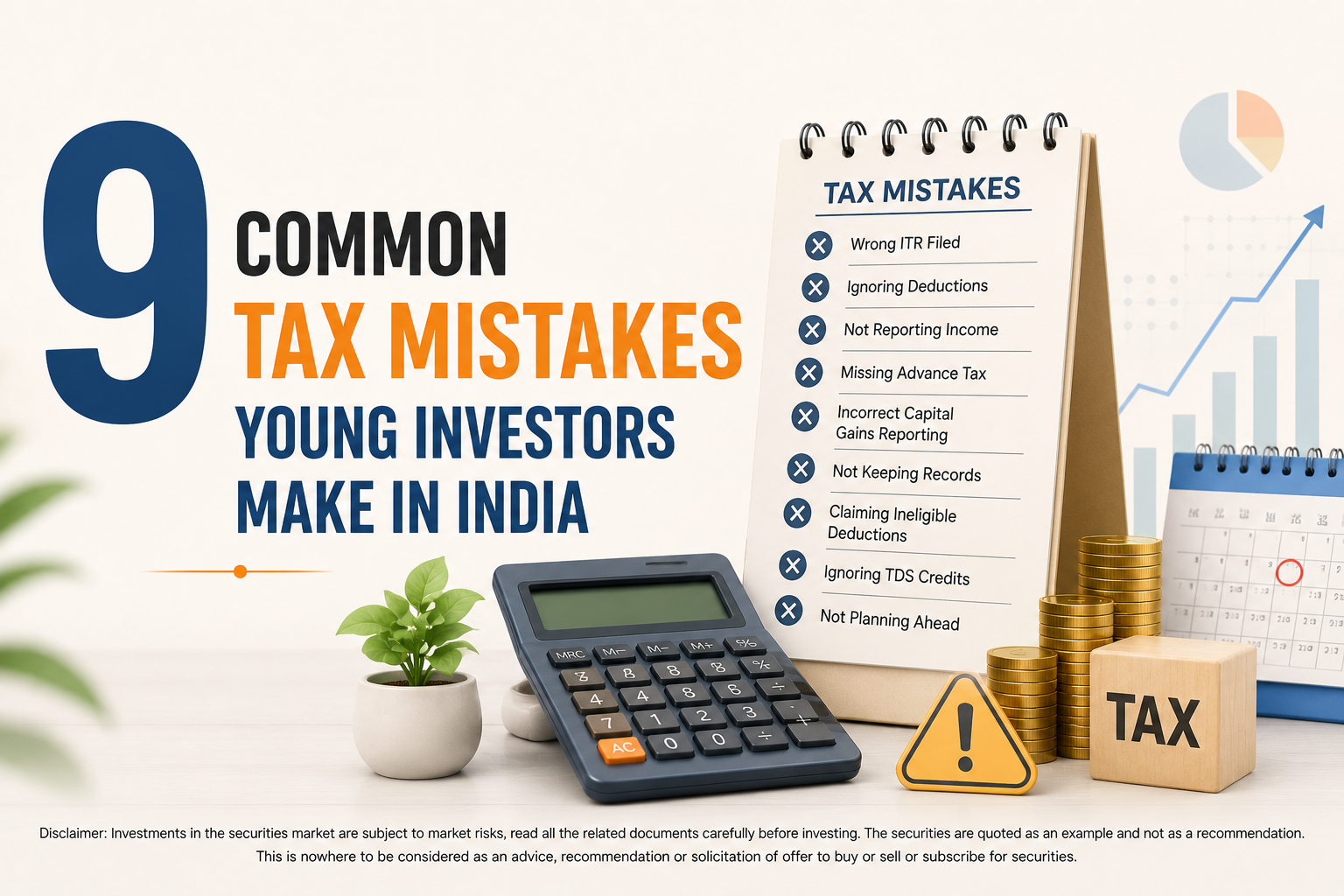
9 Common Tax Mistakes Young Investors Make in India
You start earning. Your salary finally feels decent. Maybe you begin a ₹5,000 SIP, buy a few stocks on Zerodha, or put money into a fixed deposit because your parents said it’s “safe.”
Then March arrives.
Suddenly, everyone around you is talking about Section 80C, Form 16, old vs new tax regime, and tax-saving investments you should have made months ago. That’s where most young investors realise something uncomfortable: earning money is one thing. Managing taxes around that money is a completely different skill.
And honestly? Most people learn it late.
TL;DR
- Young investors often delay tax planning until the last minute.
- Many focus only on Section 80C and ignore deductions like 80D and NPS.
- Investment returns, FD interest, and freelance income are taxable.
- Buying insurance just for tax savings is usually a bad financial decision.
- Filing your ITR matters even if your tax liability is low or zero.
Why Young Investors Make Tax Mistakes So Often
Most people in their 20s are not avoiding taxes intentionally. They are simply overwhelmed.
One month, you are comparing mutual funds. The next month, your HR asks for investment proofs. Somewhere in between, a friend tells you to buy an ELSS fund because “tax bach jayega.”
This is where things get messy.
Indian taxes are full of small rules that seem harmless initially but compound over time. A missed deduction here. An unreported FD interest there. A forgotten freelance payment. Individually, they feel small. Together, they quietly reduce your wealth.
The good news? Most of these mistakes are completely avoidable once you know where to look.
1. Waiting Until March for Tax Planning
This is probably the most common mistake young earners make.
Around February, panic starts. People rush to buy random tax-saving insurance policies, lock money into investments they barely understand, or ask colleagues for “best 80C options.”
That usually leads to poor decisions.
Good tax planning is not something you do in the final two weeks of the financial year. It works best when done slowly over 12 months.
Why does this hurt your finances
When you delay:
- You invest emotionally instead of logically
- You buy products for tax savings, not financial goals
- Your monthly cash flow gets disrupted
- You miss compounding opportunities
A ₹5,000 monthly SIP started in April feels manageable.
A ₹60,000 lump sum in March feels painful.
Simple Fix
Review your tax-saving strategy at the beginning of the financial year itself. April is ideal.
Spread investments gradually through SIPs into:
- ELSS mutual funds
- NPS
- PPF
- Tax-saving FDs if appropriate
Your paisa grows more efficiently when decisions are calm, not rushed.
2. Thinking Section 80C Is the Only Tax Benefit
Ask most young professionals about tax savings, and they immediately mention Section 80C.
That’s because it gets the most attention. Under Section 80C, you can claim deductions up to ₹1.5 lakh through investments like:
- ELSS mutual funds
- PPF
- EPF
- Life insurance premiums
- Tax-saving FDs
But many people stop there.
They completely ignore other deductions that can reduce taxable income further.
Other Important Tax Deductions Young Investors Miss
| Deduction Section | What It Covers | Why It Matters |
|---|---|---|
| 80D | Health insurance premiums | Helps reduce medical financial risk |
| 80CCD(1B) | Extra NPS contribution up to ₹50,000 | Additional deduction beyond 80C |
| 80E | Education loan interest | Useful for young professionals with student loans |
| 80TTA | Savings account interest | Small deduction, many forget |
YISM Tip Box 💡
Most people treat taxes like a year-end problem. Smart investors treat taxes like part of wealth-building itself.
A good tax-saving strategy should improve your long-term finances — not just reduce this year’s tax bill.
3. Ignoring Tax on Investment Returns
This surprises people every time.
Paying income tax on your salary does not mean your investment returns become tax-free automatically.
Different investments have different tax rules.
Commonly Taxed Investment Income
Equity Mutual Funds and Stocks
- Short-term capital gains (held under 12 months): taxed at 20%
- Long-term gains above ₹1.25 lakh: taxed at 12.5%
Fixed Deposits and Recurring Deposits
Interest earned is fully taxable according to your income tax slab.
Savings Account Interest
Even this is taxable beyond the allowed deduction limits.
Dividends
Dividend income from stocks and mutual funds is taxable in your hands.
A lot of young investors forget to declare these earnings because the amounts initially seem small.
But the Income Tax Department already receives much of this data through your PAN.
Simple Fix
Before filing your ITR:
- Review Form 26AS
- Check AIS (Annual Information Statement)
- Match your broker statements and bank interest certificates
Do not assume “small amount hai, nobody will notice.”
Most of it is already digitally tracked.
4. Buying Insurance Only to Save Tax
This is one of the oldest traps in Indian personal finance.
A relationship manager or family friend says:
“Sir, tax bhi bachega aur investment bhi ho jayega.”
Then comes a complicated ULIP or endowment policy with:
- low returns,
- long lock-ins,
- and inadequate life cover.
Here’s the truth.
Insurance and investing serve different purposes.
Trying to combine both usually creates mediocre outcomes.
What Young Investors Should Do Instead
| Goal | Better Option |
|---|---|
| Financial protection | Pure term insurance |
| Wealth creation | Mutual funds, index funds, NPS |
| Tax saving | ELSS, PPF, NPS |
A simple term plan gives much higher coverage at a lower premium.
Then you can separately invest in products that actually generate better long-term returns.
5. Forgetting to Report Freelance or Side Income
The Indian workforce has changed dramatically.
A salaried employee today might also:
- freelance on weekends,
- earn affiliate income,
- consult online,
- create YouTube content,
- or run a small side business.
The problem?
Many assume this income is “informal” and does not need reporting.
That is risky.
Platforms, clients, and payment gateways often report transactions linked to your PAN.
Real-world example
A Bengaluru designer earning ₹85,000 monthly salary also made ₹2.4 lakh from freelance UI projects last year.
She ignored it while filing taxes because no TDS was deducted.
A mismatch notice arrived months later.
Not catastrophic. But stressful and avoidable.
Simple Fix
Maintain:
- invoices,
- payment records,
- expense proofs,
- and separate bank tracking for freelance income.
You may also legally claim work-related expenses like:
- internet bills,
- software subscriptions,
- office equipment,
- and professional tools.
6. Ignoring NPS Because Retirement Feels Too Far Away
Most people in their 20s hear “retirement planning” and mentally switch off.
Fair enough.
Retirement at 60 feels unreal when you are deciding whether to upgrade your iPhone.
But this is exactly why NPS becomes powerful early.
Why NPS Matters for Young Investors
The National Pension System offers:
- additional ₹50,000 deduction under Section 80CCD(1B),
- equity exposure,
- low expense ratios,
- and long-term compounding.
Even modest contributions started early can build a meaningful retirement corpus.
Example
A 25-year-old investing ₹3,000 monthly into NPS may build a substantially larger corpus than someone starting at 40 with double the contribution.
Time matters more than intensity in long-term investing.
7. Forgetting Capital Gains Reinvestment Rules
Young investors often think capital gains taxation only matters to wealthy people.
Not true anymore.
Even modest profits from:
- mutual funds,
- property,
- gold,
- or stocks
can create tax liability.
But many people do not realise certain reinvestment provisions exist.
Example: Property Capital Gains
Under specific conditions:
- reinvesting gains into another residential property,
- or specified Section 54EC bonds,
can reduce capital gains tax liability.
Simple Fix
Before selling major assets:
- understand holding periods,
- tax rates,
- and exemption rules.
One informed decision can save lakhs in taxes later.
8. Not Filing Income Tax Returns at All
This is more common than people think.
Some young earners assume:
“My employer already deducted TDS, so I don’t need to file.”
Others think:
“My income is below the taxable limit, so why bother?”
Bad idea.
Why Filing ITR Still Matters
An Income Tax Return helps when applying for:
- credit cards,
- home loans,
- education loans,
- visas,
- and financial verification processes.
It also creates financial history.
Think of it like a financial report card.
No immediate reward perhaps — but extremely useful later.
Simple Fix
File your ITR every year, even if:
- your taxable income is low,
- your refund amount is tiny,
- or your taxes are already deducted.
Future-you will thank you.
9. Blindly Trusting HR or Finance Apps
Apps are useful.
HR payroll systems help.
But neither fully understands your personal finances.
This surprises people.
Sometimes:
- deductions are missed,
- old tax regime assumptions are incorrect,
- or investment proofs are incomplete.
And eventually, the responsibility still falls on you.
Before Filing Your ITR, Always Check:
- Form 16
- Form 26AS
- AIS
- Bank interest statements
- Mutual fund capital gains statements
- Freelance income records
A 15-minute review can prevent months of correction later.
The Nevesh Bottom Line
Most tax mistakes do not happen because people are careless.
They happen because taxes feel boring until they suddenly become expensive.
The earlier you understand how taxation works around SIPs, capital gains, insurance, and side income, the easier wealth creation becomes. Smart Nevesh is not only about higher returns. It is also about keeping more of what you earn.
This week, do one thing:
Log into your investment app, download your tax statements, and actually look at them. That tiny habit alone will put you ahead of most young investors in India.
FAQs (Frequently Asked Questions)
Q) What is the biggest tax mistake young investors make?
The biggest mistake is delaying tax planning until the final months of the financial year. This usually leads to rushed investment decisions and poor product choices. Starting early helps spread investments across the year and improves long-term financial discipline.
Q) Are SIP returns taxable in India?
Yes. SIP investments in equity mutual funds are subject to capital gains tax. Short-term gains are taxed differently from long-term gains, and long-term gains above ₹1.25 lakh annually are taxable under current rules.
Q) Is NPS better than ELSS for tax saving?
They serve different purposes. ELSS offers better liquidity with a shorter lock-in period, while NPS focuses more on retirement planning and provides an additional ₹50,000 deduction under Section 80CCD(1B). Many investors use both together.
Q) Do I need to file ITR if my employer already deducts TDS?
Yes, in most cases, you still should. Filing an Income Tax Return creates official financial records useful for loans, visas, and refunds. It also helps verify whether excess tax was deducted during the year.
Q) Is freelance income taxable in India?
Yes. Freelance income, consulting fees, side gigs, and creator earnings are taxable under Indian income tax rules. Even small secondary income streams should be properly reported while filing returns.
Q) Can health insurance reduce taxable income?
Yes. Premiums paid for health insurance can qualify for deductions under Section 80D. This helps reduce taxable income while also protecting you from unexpected medical expenses.
Disclaimer:
Mutual fund investments are subject to market risks. Read all scheme-related documents carefully.
This article is for educational purposes only and does not constitute financial advice. Please consult a SEBI-registered advisor before making investment decisions.
Young India. Smart Money.