

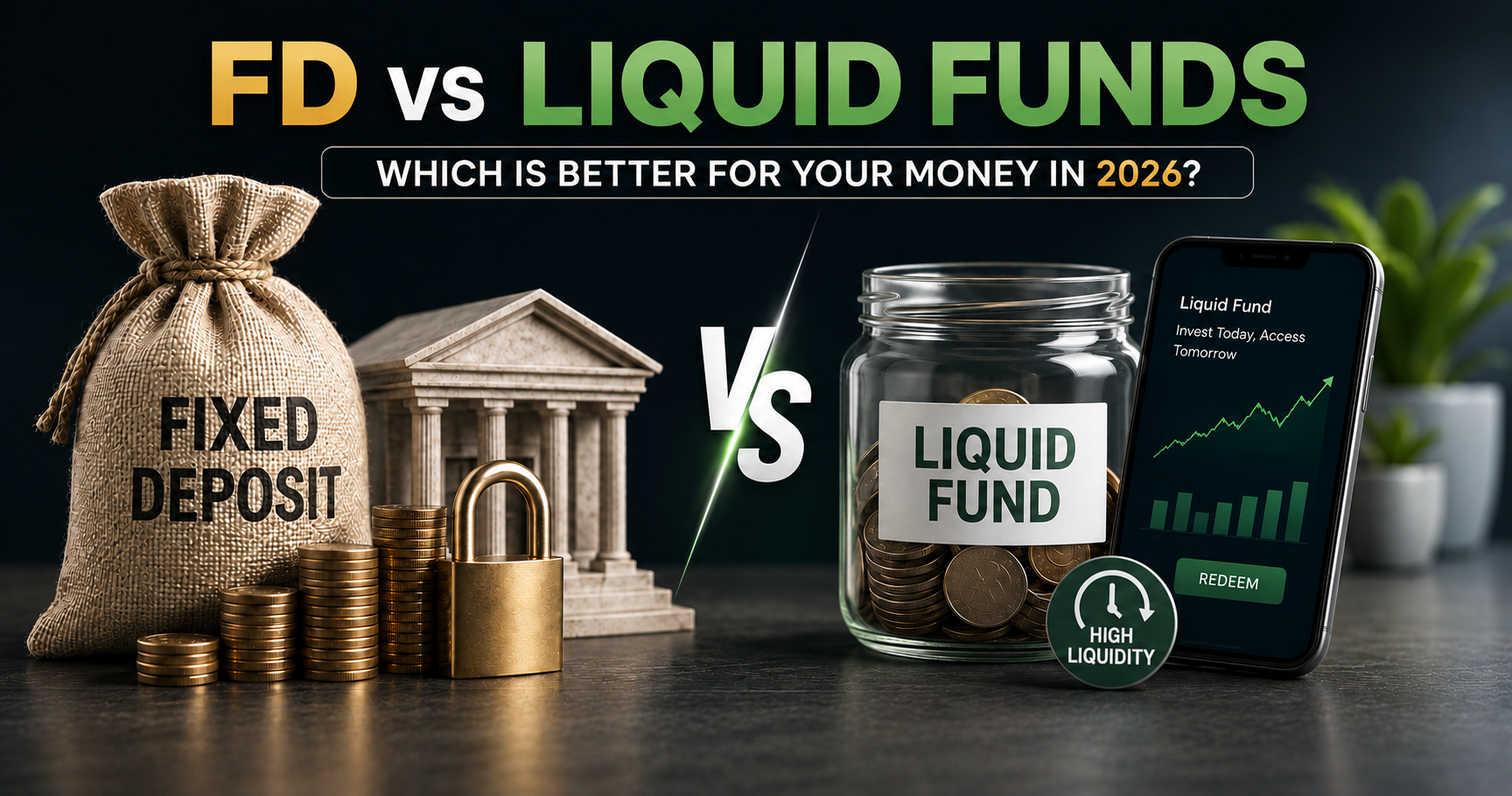
There comes a point in almost everyone’s financial journey when they have some money lying idle.
Maybe you’ve received your annual bonus. Maybe you’ve sold a property, received a maturity amount from an insurance policy, or simply managed to save a few lakhs over the years.
The question is always the same. “Where should I keep this money?”
For decades, the answer in most Indian households has been straightforward: put it in a fixed deposit.
Parents recommend it. Banks promote it. It feels familiar, but over the last few years, another option has quietly become popular among investors who want their money to remain accessible while earning a better return than a savings account.
That’s where liquid funds enter the picture.
If you’ve been trying to decide between a fixed deposit (FD) and a liquid fund, you aren’t alone. Both are considered relatively low-risk. Both are used for short-term money. Yet they work very differently. Choosing the wrong one won’t ruin your finances, but choosing the right one can make managing your cash a lot easier.
Let’s understand where each option fits.
What Is a Fixed Deposit?
A fixed deposit is one of the oldest investment products available in India. You deposit a lump sum with a bank for a fixed period, and the bank agrees to pay a predetermined rate of interest.
Nothing about the return depends on the stock market.
Nothing changes midway.
If your bank promises 7% for three years, you’ll receive exactly that unless you break the deposit before maturity. That’s precisely why FDs continue to remain popular, especially among retirees and conservative investors.
Most banks today offer tenures ranging from seven days to ten years. Some even provide monthly, quarterly or annual interest payouts for people who rely on regular income. The biggest attraction, though, isn’t the return.
It’s certainty.
You know exactly how much money you’ll receive when the FD matures. That predictability gives many investors peace of mind.
Of course, there’s a trade-off.
If you suddenly need the money before maturity, you can withdraw it, but the bank usually charges a premature withdrawal penalty. You’ll also receive a lower interest rate than originally promised.
What Is a Liquid Fund?
A liquid fund belongs to the debt mutual fund category.
Instead of lending your money directly to a bank, you’re investing through a mutual fund that purchases very short-term debt instruments such as Treasury bills, commercial papers, certificates of deposit and other money market securities.
SEBI requires liquid funds to invest only in securities with a maturity of up to 91 days. This short maturity period is one reason liquid funds generally experience very little price movement compared to other debt funds.
Unlike an FD, there is no fixed investment period. You can invest today and redeem tomorrow or just leave the money invested for several months.
The return isn’t guaranteed because it depends on prevailing short-term interest rates. That uncertainty makes some investors uncomfortable.
However, in exchange, you get considerably more flexibility.
Why Are Investors Comparing FDs and Liquid Funds?
At first glance, they seem to solve the same problem. You have money that you don’t want sitting in a savings account. You also don’t want to expose it to stock market volatility, so naturally, the comparison begins.
Both products are designed for relatively short investment horizons.
Both are considered lower risk than equity investments.
Both allow your money to earn more than a typical savings account.
That’s where the similarities end, where one offers certainty and the other offers convenience.
One locks your money for a chosen tenure. The other lets you access it almost whenever you want.
Understanding those differences matters much more than comparing last year’s returns.
FD vs Liquid Funds: A Quick Comparison
| Feature | Fixed Deposit | Liquid Fund |
| Returns | Fixed and guaranteed | Market-linked |
| Risk | Very Low | Low |
| Liquidity | Moderate | High |
| Lock-in | Fixed tenure | No lock-in |
| Premature Exit | A penalty may apply | Generally no penalty after applicable exit load period |
| Taxation | Interest taxed as per income slab | Gains taxed as per applicable debt fund rules |
| Best For | Investors seeking certainty | Parking short-term surplus money |
Looking only at the table, neither option appears better that’s because they aren’t designed to replace one another.
They solve different problems.
Which One Is Safer?
If safety means knowing exactly what you’ll receive at maturity, a fixed deposit has the advantage.
The interest rate is fixed from the beginning market conditions don’t affect your return, and there’s another layer of comfort as well.
Deposits held with scheduled banks are covered by deposit insurance through the Deposit Insurance and Credit Guarantee Corporation (DICGC), up to ₹5 lakh per depositor per bank, including both principal and accumulated interest.
That protection doesn’t apply to company FDs or deposits with NBFCs. Liquid funds don’t come with deposit insurance.
Instead, they reduce risk by investing across multiple high-quality short-term securities rather than relying on a single borrower. They’re also tightly regulated by SEBI.
Can liquid funds lose money? Technically, yes.
Practically, significant losses in a well-managed liquid fund are uncommon because of the high-quality assets and short maturity profile they maintain. Still, unlike an FD, returns aren’t guaranteed.
Which Option Offers Better Returns?
This is probably the first question most investors ask. The honest answer is that there isn’t a permanent winner.
An FD gives you certainty. A liquid fund gives you the opportunity to benefit from changing interest rates.
Suppose interest rates begin rising. A liquid fund can gradually start earning higher yields because the securities inside the portfolio mature quickly and get replaced with newer instruments carrying better rates.
An FD doesn’t have that flexibility. You’re locked into the interest rate agreed upon when you invested.
The opposite is also true.
If interest rates start falling, someone who locked money into a high-rate FD earlier may end up earning more than investors in liquid funds. So comparing one year’s returns rarely tells the full story.
Interest rate cycles matter.
Timing matters. More importantly, your objective matters. If your priority is certainty, returns become secondary. If flexibility matters more, liquid funds become harder to ignore.
Liquidity: Where Liquid Funds Have an Edge
The clue is right there in the name. Liquid funds are designed to provide quick access to your money.
Most redemption requests are credited by the next business day. Many fund houses also offer instant redemption facilities within prescribed limits, making small withdrawals available almost immediately.
That makes them useful for emergency funds or money you may need without warning. An FD works differently. Yes, you can break it before maturity. But doing so usually means accepting a lower interest rate and paying a premature withdrawal penalty.
It’s not complicated. It’s simply less convenient. For someone building an emergency fund, convenience matters just as much as returns.
How Are FDs and Liquid Funds Taxed in 2026?
Taxation is one area where many investors still carry outdated information. For years, debt mutual funds enjoyed an advantage because long-term investors could claim indexation benefits. That changed with the amendments introduced in April 2023.
As of June 2026, both FDs and most liquid funds are taxed at your applicable income tax slab, but the way the tax is collected is slightly different.
Tax on Fixed Deposits
Interest earned from an FD is treated as “income from other sources”. It gets added to your total taxable income and is taxed according to your income tax slab.
Banks are also required to deduct Tax Deducted at Source (TDS) once your interest crosses the prescribed threshold during a financial year. Even if no TDS is deducted, you’re still responsible for reporting the interest while filing your income tax return.
Tax on Liquid Funds
Liquid funds purchased after 1 April 2023 no longer receive indexation benefits. Any gains are taxed at your applicable income tax slab when you redeem your investment.
One small advantage remains.
With an FD, interest is taxed every year as it accrues. A liquid fund is taxed only when you actually redeem your units. If you’re holding the investment for a while, this type of fund can slightly improve cash flow because the tax outgo is deferred.
It’s not a dramatic advantage, but it is worth knowing.
FD vs Liquid Funds for an Emergency Fund
Every financial planner talks about building an emergency fund. Fewer people explain where that money should actually sit. Some investors keep the entire amount in a savings account. Others lock everything into FDs. Neither approach is ideal.
An emergency fund needs to satisfy two conditions. First, the money should be available immediately. Second, it should remain reasonably safe.
Liquid funds are often well suited for this role because they offer quick access, no fixed tenure and the flexibility to withdraw only the amount you need. The rest of the investment can continue earning returns.
That said, some investors simply sleep better knowing their emergency money sits in a bank FD. There’s nothing wrong with that. Financial planning isn’t only about mathematics. Behaviour matters too.
A practical approach followed by many experienced investors is to divide the emergency corpus. Keep one or two months of expenses in a savings account or sweep-in FD for immediate access.
Park the remaining amount in a liquid fund, where it can potentially earn a little more without becoming difficult to access.
When Does an FD Make More Sense?
Despite newer investment products, FDs continue to have an important place in many portfolios.
You may prefer an FD if:
- You want guaranteed returns with no surprises.
- You already know when you’ll need the money.
- You dislike any market-linked investment, even if the risk is minimal.
- You’re investing money meant for a fixed future expense, such as school fees or a planned purchase.
- You rely on regular interest income during retirement.
For many people, peace of mind is worth more than squeezing out an extra half a percentage point of return.
When Is a Liquid Fund the Better Choice?
Liquid funds are designed for flexibility.
They usually work well when:
- You’re temporarily parking surplus cash.
- You’ve received a bonus and haven’t yet decided where to invest it.
- You’re waiting to invest in equity mutual funds through a Systematic Transfer Plan (STP).
- You’re building an emergency fund.
- You want easy access without worrying about breaking an FD.
- You may need only part of your money rather than the entire amount.
Liquid funds aren’t meant to replace long-term investments.
They’re simply a smarter parking space for money that shouldn’t remain idle.
Risks You Should Know Before Investing
Neither product is completely risk-free. The risks are simply different.
Risks Associated with Fixed Deposits
Inflation is perhaps the biggest hidden risk.
If inflation averages 6% and your FD earns 6.5%, your purchasing power barely improves after tax.
Another issue is reinvestment risk. Suppose your FD matures when interest rates have fallen sharply.
You’ll have no choice but to reinvest at lower rates. Premature withdrawals can also reduce your effective return because banks generally impose penalties.
Risks Associated with Liquid Funds
Liquid funds carry limited credit and interest-rate risk. Although fund managers invest largely in high-quality instruments, there remains a small possibility that an issuer could face financial stress.
Returns also change with market interest rates. Unlike an FD, there is no promised rate of return.
While losses are uncommon in well-managed liquid funds, investors should still remember that they are mutual funds, not bank deposits.
Common Mistakes Investors Make
Choosing between an FD and a liquid fund isn’t usually where mistakes happen. Problems arise when investors use the wrong product for the wrong purpose.
Some common examples include:
- Locking emergency money into long-tenure FDs.
- Chasing slightly higher returns without understanding the risks involved.
- Comparing only last year’s returns instead of looking at liquidity and flexibility.
- Investing in company FDs assuming they carry the same safety as bank deposits.
- Ignoring taxation while calculating actual post-tax returns.
- Investing every rupee in one product instead of diversifying.
Often, the best solution isn’t choosing one over the other. It’s using both in the right proportion.
The Nevesh View Point
The debate between FDs and liquid funds often becomes a search for a winner.
In reality, there isn’t one.
An FD isn’t outdated simply because mutual funds exist, and liquid funds aren’t automatically better because they offer flexibility.
Ask yourself one question before investing:
“What job is this money supposed to do?”
If the money has a fixed purpose and a known timeline, an FD may be exactly what you need.
If you’re waiting for the right investment opportunity, building an emergency fund or managing surplus cash, a liquid fund could make life easier.
The best financial plans rarely rely on a single product. They combine different tools for different goals.
Instead of asking which investment is superior, focus on which one suits your situation today.
That’s usually where the right answer lies.
Frequently Asked Questions
1. Which is better in 2026: an FD or a Liquid Fund?
Neither is universally better. Fixed deposits are suitable for investors who want guaranteed returns and certainty. Liquid funds work better for people who value liquidity and flexibility while parking short-term money.
2. Can a liquid fund lose money?
Yes, although the chances are generally low. Liquid funds invest in short-term debt securities, so returns are market-linked. Small fluctuations can occur, but high-quality liquid funds have historically remained relatively stable.
3. Are bank FDs completely safe?
Bank FDs are among the safest investment options available. Deposits with scheduled banks are insured by the Deposit Insurance and Credit Guarantee Corporation (DICGC) up to ₹5 lakh per depositor per bank, covering both principal and interest.
4. Which option is better for an emergency fund?
Many financial planners prefer liquid funds because they provide quick access without locking your money for a fixed tenure. However, conservative investors may prefer keeping at least a portion of their emergency corpus in a savings account or sweep-in FD.
5. Are liquid funds taxed differently from FDs?
As of June 2026, both are generally taxed at the investor’s applicable income tax slab. The key difference is that FD interest is taxed every year as it accrues, while gains from liquid funds are taxed when units are redeemed.
6. Can I invest in both?
Yes. In fact, many investors do. An FD can provide certainty for planned expenses, while a liquid fund can be used for emergency savings and temporary parking of surplus money.
Risk Disclaimer
This article is meant for educational purposes only and should not be considered investment, tax or financial advice. Investment decisions should be based on your financial goals, investment horizon and risk tolerance. Tax laws and mutual fund regulations may change over time. Before investing, consult a qualified financial advisor or chartered accountant for personalised guidance. Mutual fund investments are subject to market risks. Read all scheme-related documents carefully before investing.