

A ₹10 crore seed round usually does not attract much attention outside the startup ecosystem.
Tulön Materials may be an exception.
The Mumbai-based speciality chemicals company has raised ₹10 crore in seed funding led by investor Karthik Sundar Iyer, with participation from Karan Goshar and Prakhar Pandey, partners at Valour Capital, who invested in their personal capacities, along with angel investor Agam Shah. The capital is being directed towards engineering, product development and commercialisation across paints and coatings, printing inks and adhesives. (ETEntrepreneur.com)
On the surface, this looks like another early-stage funding announcement in India’s expanding deep-tech ecosystem.
But Tulön is building in a part of the economy most consumers never see.
Its products sit much closer to the industrial raw-material layer than to the finished product. The company develops speciality chemicals, resins, binders and additives used across applications, including coatings, printing inks, adhesives, plastics and polymers, and paper and textile processing. More importantly, it is trying to replace part of the traditional dependence on virgin fossil-derived feedstocks with materials sourced through waste upcycling and renewable inputs. (Tulön Materials)
That makes the company interesting for a reason beyond sustainability.
Tulön is betting that waste can become an industrial input and that the economics of making that transition can eventually be attractive enough for manufacturers to pay for it.
That is a much harder proposition than simply selling a greener product.
The business behind the funding
Founded in June 2022 by Asesh Sarkar, Dr Rabindranath Mandal and Harsh Bhatt, Tulön Materials describes itself as an R&D-led speciality chemicals manufacturer focused on high-performance and sustainable materials. The founders collectively bring decades of chemical-industry experience, giving the company a very different starting point from a typical consumer startup. (ETEntrepreneur.com)
The distinction matters.
Speciality chemicals are not a business where a good presentation or a large marketing budget can compensate for weak technology. Customers care about consistency, performance, formulation compatibility, regulatory requirements and, eventually, price. A material can be environmentally attractive and still fail commercially if it does not perform as well as the incumbent product.
Tulön therefore appears to be pursuing a fairly pragmatic proposition: make the sustainable alternative good enough technically and attractive enough economically that industrial customers have a reason to switch.
Its own description of the business reflects that thinking. The company says it follows a “revenue-first, deep-tech” approach, focusing on intellectual property that addresses existing industrial problems rather than developing technology without a clear commercial application.
That is an important distinction in a sector where R&D cycles can be long, and customer validation can take time.
The company currently lists applications across paints and coatings, printing inks, plastics and polymers, and paper and textiles. Its portfolio includes resins and additives for architectural and industrial coatings, binders for printing inks and adhesives, and speciality additives designed to improve material performance. (Tulön Materials)
The current company profile also lists a headquarters and R&D laboratory in Turbhe, Mumbai, a thioester production facility in Mahad and a resin manufacturing facility in Visakhapatnam. (Tulön Materials)
That footprint is worth watching because it points to something investors often overlook in deep-tech businesses: the distance between inventing a material and manufacturing it reliably at scale.
The more interesting part is what happens to plastic waste
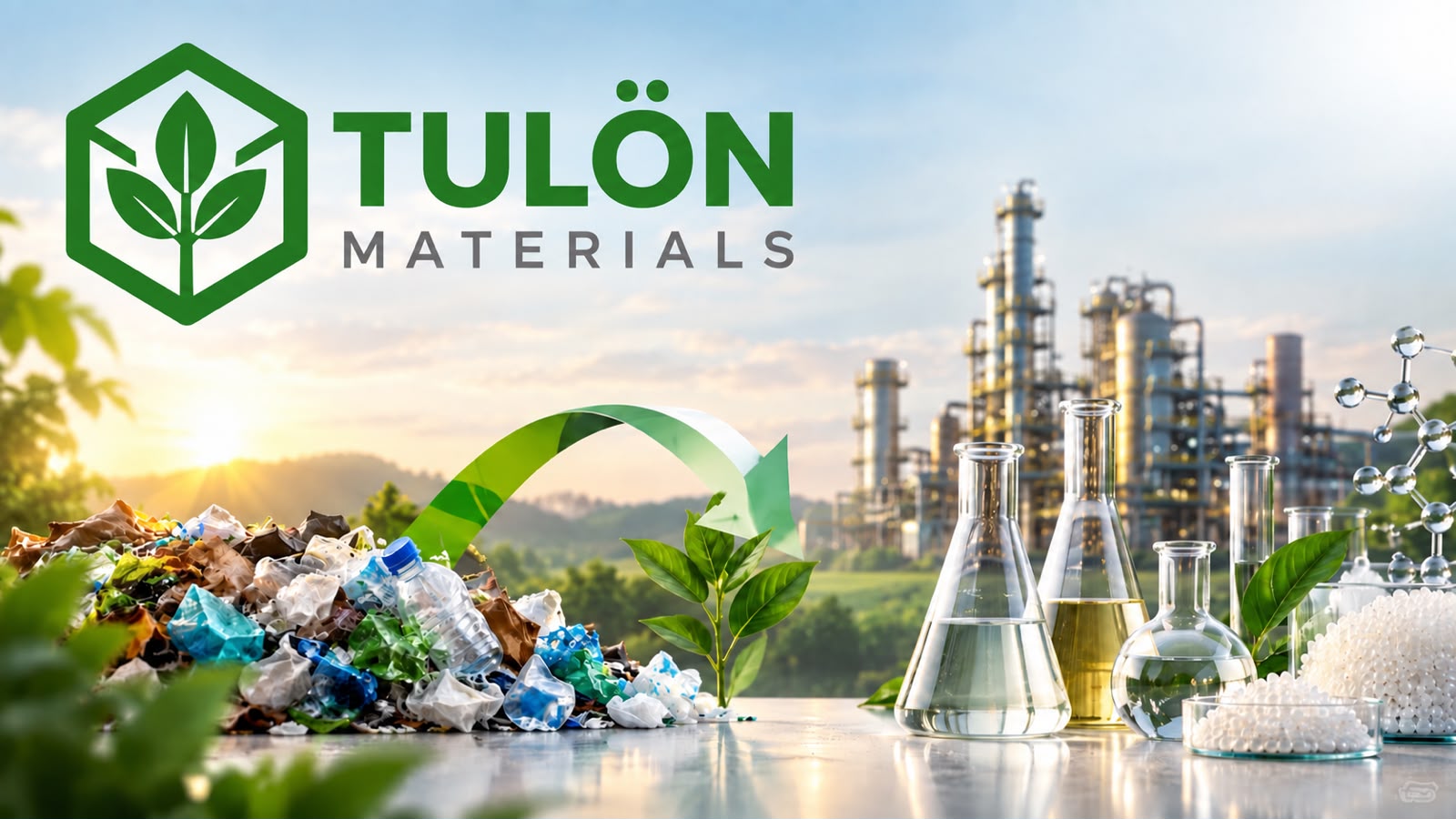
The centrepiece of Tulön’s technology story is its plastic-waste upcycling platform.
According to the company and multiple reports around the funding, Tulön is working on a proprietary process that can convert complex polymer waste streams into chemical resins suitable for industrial applications. (ETChemicals.com)
This is materially different from conventional recycling.
Traditional mechanical recycling generally tries to recover plastic in a form that can be processed again. Chemical upcycling takes a more fundamental approach by breaking down or transforming difficult waste streams so that their chemical components can become inputs for new materials.
That distinction becomes particularly relevant when dealing with mixed or contaminated polymer waste that is difficult to recycle mechanically.
For a company like Tulön, the opportunity is not simply “recycle more plastic.”
The larger opportunity is to create new industrial feedstock from material that would otherwise have limited economic value.
If the process works at scale, the same waste stream that creates a disposal problem can potentially become part of the supply chain for resins and other speciality materials.
That changes the economics of the sustainability conversation.
Instead of asking manufacturers to pay a premium because something is greener, the proposition becomes: can an alternative feedstock deliver acceptable performance, supply reliability and cost while also reducing dependence on virgin fossil inputs?
That is the commercial question Tulön ultimately has to answer.
Why specialty chemicals are a difficult but attractive market
India has spent years building capabilities in specialty chemicals, with companies increasingly moving from commodity manufacturing towards higher-value products.
The attraction is straightforward.
Specialty chemicals tend to be closer to the customer’s manufacturing process. Performance matters more than simply producing the cheapest tonne of chemical. Once a product is qualified and incorporated into a customer’s formulation or process, switching suppliers can also become more involved.
That can create stronger customer relationships and better economics for companies that manage to develop differentiated products.
But getting there is not easy.
A specialty chemical company may spend considerable time developing a formulation before a large customer even begins commercial procurement. Products need to undergo testing, validation and often multiple rounds of modification. Production has to be consistent. Regulatory requirements can become more demanding as products move into international markets.
Tulön appears to understand this part of the business.
Its model includes an open-innovation approach involving industry partners, research institutions and customers in product validation and application development. The company also says it is using AI in chemical simulation, validation and R&D workflows to shorten development cycles. (Tulön Materials)
The AI component is interesting, but it should not be mistaken for the core investment thesis.
AI can help researchers simulate, test and narrow down possibilities faster.
It cannot by itself create customer demand, guarantee manufacturing consistency or make an uneconomic chemical process profitable.
The real moat, if Tulön succeeds, will likely come from the combination of chemistry expertise, proprietary processes, intellectual property, manufacturing capability and customer validation.
That combination is much harder to replicate than an AI application.
Why investors are paying attention now
The ₹10 crore round comes at an interesting point for industrial sustainability.
Companies across manufacturing are facing pressure to reduce emissions, rethink raw materials and improve the environmental profile of their supply chains. At the same time, they cannot simply sacrifice performance or economics to achieve those goals.
This creates an uncomfortable gap.
Everyone wants more sustainable manufacturing.
Very few manufacturers can afford a material that works only because it is sustainable.
That gap is where companies such as Tulön are trying to build businesses.
The company says its material platforms are designed to reduce reliance on virgin fossil-derived feedstocks, support lower-carbon industrial processes and advance circular-economy outcomes. It is also positioning its products for international markets, including Europe, where demand for lower-carbon industrial inputs is becoming increasingly relevant. (ETChemicals.com)
Several products are reportedly undergoing technical validation with multinational enterprises, although the customers have not been publicly identified. (YourStory.com)
For an early-stage speciality chemicals company, this stage of validation may matter more than the size of the seed round itself.
A ₹10 crore cheque gives Tulön the resources to develop technology.
A successful enterprise validation gives the technology a potential route to revenue.
The second is what eventually determines whether the first was money well spent.
The founders are betting on domain expertise
Tulön’s founding team is another reason this story deserves attention.
Asesh Sarkar, Rabindranath Mandal and Harsh Bhatt bring substantial experience in the chemical industry. Harsh Bhatt is the company’s CEO, while Tulön identifies Sarkar as managing director and Mandal as director of technology & innovation. (Tulön Materials)
That background is particularly relevant in speciality chemicals.
Deep-tech manufacturing businesses often look less exciting than software startups during the early years. There may be no viral product, no rapidly growing consumer user base and no obvious network effect.
Instead, the business accumulates knowledge.
A formulation improves.
A production process becomes more reliable.
A customer completes validation.
A patent gets filed.
A second customer tests the product.
Manufacturing yields improve.
The commercial value of those small steps compounds over time.
For Tulön, the experience of its founders could therefore become an important part of the company’s ability to move between laboratory research and industrial adoption.
Bhatt himself has described Tulön’s mission as bridging the gap between deep scientific research and commercial agility. The latest funding is intended to expand the company’s IP portfolio, advance its upcycling technologies and accelerate validation timelines with enterprise partners globally. (LinkedIn)
That is a sensible use of early-stage capital for a materials company.
But the difficult questions start now
The funding announcement is encouraging.
It is not yet proof of a successful business.
That distinction is important.
The biggest question is whether Tulön can turn its technology into repeatable commercial products at an attractive cost.
Plastic waste is abundant. That does not automatically make it a cheap feedstock.
Collection, segregation, transportation, contamination, processing and quality control can all affect economics. A technology that works beautifully with a controlled laboratory feedstock may face very different economics when exposed to inconsistent real-world waste.
Then comes manufacturing.
Producing a speciality chemical in a laboratory is one problem. Producing thousands of tonnes with consistent quality, predictable yields and reliable supply is another.
Customer adoption is another hurdle.
Industrial buyers are generally conservative for good reason. A change in a resin or binder can affect an entire manufacturing process. If a new material performs differently under temperature, humidity, storage or production conditions, the cost of failure can be much greater than the price of the chemical itself.
Tulön therefore has to prove not only that its materials are sustainable, but that they are boringly reliable.
For an industrial customer, boring is often a compliment.
The European opportunity could be meaningful
Tulön’s international ambition is another part of the story worth following.
The company says it is positioning its Made-in-India materials for markets including the European Union and that products are undergoing validation with multinational companies. (YourStory.com)
Europe could become an important test of the model.
Customers in developed markets are increasingly looking at the environmental footprint of their supply chains, but they also operate under stringent technical and regulatory requirements. Successfully selling a recycled or upcycled feedstock into those markets would provide more than revenue.
It would provide validation.
That could help Tulön move from being an Indian sustainable materials startup to becoming a supplier of globally relevant speciality chemical technologies.
But the reverse is also true.
International markets can make compliance, certification, logistics and customer qualification considerably more complicated. A company that wants to export speciality chemicals needs to build more than a good laboratory.
It needs a dependable industrial system around the technology.
Where AI fits into the picture
Tulön’s use of AI is another part of the story, but it needs to be viewed in context.
The company says AI is being integrated into chemical simulation, validation and automated R&D workflows to compress product-development timelines. (YourStory.com)
That could become useful as the company expands its materials portfolio.
Chemical R&D involves large numbers of possible formulations, combinations and performance variables. Computational tools can help researchers identify promising candidates before spending time and money testing them physically.
That can potentially reduce the number of experiments required and make research teams more productive.
But AI is unlikely to be the reason Tulön wins.
The company is operating in a field where physical chemistry, process engineering and manufacturing discipline ultimately determine whether an idea becomes a product.
AI may make the research engine faster.
It does not remove the factory floor.
That is why the combination of digital tools with deep chemical expertise is more interesting than the AI label on its own.
The larger bet: making sustainability commercially useful
There is a broader lesson in Tulön’s model.
For years, sustainability in business was often presented as a trade-off.
Companies were asked to choose between lower environmental impact and higher costs.
The next generation of industrial climate businesses is trying to change that equation.
The strongest businesses will not necessarily be those that sell sustainability as a virtue.
They will be those that make sustainability economically useful.
If a recycled feedstock reduces raw-material dependence, improves product economics, meets a customer’s performance requirements and helps satisfy environmental targets, the sustainability benefit becomes part of the commercial proposition rather than the entire proposition.
That is a much more durable business model.
Tulön is still early in that journey.
But its focus on speciality chemicals gives it an interesting position because the products it is developing sit inside industrial processes where relatively small changes in materials can potentially have large downstream effects.
What investors should watch from here
The ₹10 crore seed round gives Tulön room to build.
The next milestones will matter far more than the funding headline.
Investors and industry watchers should look for evidence of commercial validation, recurring enterprise customers, manufacturing scale-up, product margins and the proportion of revenue coming from proprietary products.
The company’s ability to convert its plastic-waste upcycling technology into commercially viable resins will be particularly important.
So will the pace at which products move from technical validation into regular procurement.
The company has already established manufacturing capabilities in Maharashtra and Andhra Pradesh, according to its current website. (Tulön Materials) The next challenge is turning that infrastructure and its R&D pipeline into a scalable commercial engine.
There is also an important question around intellectual property.
If Tulön develops genuinely differentiated processes for converting difficult waste streams into high-value chemical inputs, protecting that know-how could become a meaningful competitive advantage.
But IP alone does not create a moat.
A better moat would be the combination of proprietary technology, customer approvals, manufacturing expertise, feedstock relationships and years of accumulated application knowledge.
That takes time to build.
The Nevesh View Point
Tulön Materials is not interesting simply because it has raised ₹10 crore.
It is interesting because it is attempting something much harder: turning sustainability from a compliance requirement into an industrial business proposition.
That distinction should matter to anyone following India’s next wave of deep-tech manufacturing.
The company is operating in a difficult segment, with long development cycles, demanding customers and significant scale-up risks. There is no guarantee that its plastic-waste upcycling technology will become commercially successful, and the company is still at an early stage.
But the underlying direction is compelling.
India’s manufacturing growth will require more materials, chemicals and industrial inputs. At the same time, global customers are putting greater pressure on suppliers to reduce their dependence on virgin fossil-based materials.
The opportunity sits between those two realities.
If Tulön can make waste-derived feedstocks perform like conventional materials, achieve competitive economics and secure large industrial customers, its opportunity could extend well beyond selling “green chemicals”.
It could become a materials platform built around a different idea of what the feedstock itself should be.
And that is where this story becomes bigger than one ₹10 crore seed round.
The real test for Tulön begins now: can laboratory innovation survive the economics of the factory floor?
If the answer is yes, the outcome could be one of the more interesting examples of India’s deep-tech ecosystem moving beyond software and into the physical economy.
Risk Disclaimer
Tulön Materials is an early-stage private company, and its future commercial performance remains uncertain. This article is intended for informational and editorial purposes only and should not be interpreted as investment advice, a recommendation to invest, or an assessment of the company’s valuation or future returns. Private-company information can change as new financial, operational and regulatory disclosures become available.